
Introduction#
The anchoring effect, first systematized by Tversky and Kahneman (1974) as a core heuristic in judgment under uncertainty, represents a fundamental and pervasive deviation from normative models of rational choice. This cognitive bias describes the profound and often disproportionate influence that an initially encountered piece of information, the “anchor”, exerts on subsequent numerical estimates, valuations, and decisions, even when that anchor is arbitrary or patently irrelevant. From its origins in behavioral economics and cognitive psychology, the study of anchoring has evolved into a quintessential interdisciplinary inquiry, revealing itself as a robust phenomenon with deep-seated roots in neural circuitry, modulated by individual neurochemistry and psychometric profiles, and manifesting significant consequences across organizational, legal, and digital ecosystems.
This article provides a comprehensive, multi-level analysis of the architecture of initial influence. We begin by examining the foundational cognitive theories, from the original anchoring-and-adjustment model to contemporary semantic and perceptual explanations, that seek to explain the mechanistic underpinnings of this bias. We then trace the phenomenon to its neurological substrate, exploring how specific regions of the prefrontal cortex and a delicate neurochemical balance between dopaminergic “go” signals and serotonergic “brake” mechanisms govern our susceptibility. Furthermore, we analyze the critical individual differences in susceptibility, delineating how cognitive reflection, personality, and affective states interact to moderate the effect’s power.
Beyond the individual, the article investigates the translational impact of anchoring in high-stakes professional domains. We document its role as a primary driver in negotiation outcomes, financial market inefficiencies, and corporate strategic inertia. In the legal arena, we explore its troubling influence on judicial sentencing and jury awards, demonstrating how salient numerical prompts subvert expert judgment. Finally, we confront the emerging frontier of algorithmic anchoring, where artificial intelligence systems function as potent new sources of bias within digital choice architectures, posing novel challenges to human autonomy and decision quality.
By synthesizing evidence from cognitive science, neuroscience, behavioral economics, and organizational theory, this analysis aims not only to elucidate the complex, layered architecture of the anchoring effect but also to frame it as a critical lens through which to understand human rationality. In an era of increasing information complexity and algorithmic mediation, a systematic understanding of this bias is imperative for developing effective debiasing strategies and designing decision environments that foster accuracy, equity, and reflective judgment.
The Genesis of Heuristic Theory: Tversky and Kahneman’s Paradigm Shift#
The formal recognition of the anchoring effect emerged from a broader challenge to the “rational actor” model of economic theory. In their seminal 1974 paper, “Judgment under Uncertainty: Heuristics and Biases,” Amos Tversky and Daniel Kahneman introduced anchoring and adjustment as one of three fundamental heuristics, alongside representativeness and availability, that humans use to simplify estimation. These heuristics are described as cognitive “short cuts” that are generally economical and effective but can lead to systematic, predictable errors.
The classic experimental demonstration of this effect involved a wheel of fortune rigged to stop only on the numbers 10 or 65. Participants were first asked to judge whether the percentage of African countries in the United Nations was higher or lower than the number on the wheel. Subsequently, they provided an absolute estimate of that percentage. The results were dramatic: those who saw the number 10 provided a median estimate of 25%, while those who saw 65 provided a median estimate of 45%. This outcome illustrated that even an obviously random starting point could skew human judgment by 20 percentage points.
Theoretical Frameworks: The Mechanics of Influence#
The debate surrounding the underlying mechanisms of anchoring has evolved from a simple adjustment-based model to more complex semantic and perceptual theories. Several primary explanatory models define this evolution. The Anchoring-and-Adjustment model posits a mechanism of serial adjustment, where judges start at the anchor and adjust away until a plausible value is reached; however, this adjustment is typically insufficient and stops at the boundary of an acceptable range. In contrast, the Selective Accessibility model relies on semantic priming, in which the comparison task activates anchor-consistent knowledge, increasing the accessibility of information confirming that the target is similar to the anchor.
Beyond these, the Scale Distortion model suggests perceptual re-scaling, where the anchor distorts the numerical scale itself; for instance, a high anchor makes subsequent values on the same scale appear smaller. Finally, the Numeric Priming model focuses on value activation, where mere exposure to several primes that are valued in the mental representation makes them more likely to be retrieved in the next task.
While the original Tversky and Kahneman model focused on the “adjustment” phase, contemporary research, particularly the work of Strack and Mussweiler, highlights the “selective accessibility” of knowledge. According to this model, when a person is asked whether the average temperature in Antarctica is higher or lower than -10 degrees Celsius, they do not just compare numbers; they engage in a hypothesis-testing process. They mentally test the possibility that the temperature is -10 degrees, which selectively activates memories and facts consistent with that value (e.g., thoughts of ice, shivering, or frozen landscapes). This pool of accessible, anchor-consistent information then biases the final, absolute judgment.
The strength of the semantic model is supported by findings that anchoring is significantly reduced when the anchor’s dimension does not match the target’s. For example, anchoring an estimate of a building’s height to a value related to its width produces a much weaker effect than anchoring it to a height-related value. This suggests that anchoring is not just a mathematical error but a deeper semantic distortion in how we perceive an object’s attributes.
The Neurological Substrate: Mapping the Biased Brain#
Advances in neuroeconomics and functional neuroimaging have provided a biological map of how anchors are processed and why they are so difficult to override. The anchoring-and-adjustment process is primarily localized in the prefrontal cortex and the basal ganglia and involves both executive control and reinforcement-learning circuits.
Prefrontal Engagement and Social Anchoring#
The medial prefrontal cortex (MPFC) has been identified as a critical hub for anchoring, particularly in social contexts. When individuals attempt to understand others’ mental states, a process known as mentalizing, they often use themselves as the initial anchor. They start with their own preferences or thoughts, then adjust serially to account for perceived differences in the other person.
Functional MRI studies have demonstrated regional specialization within the MPFC for this task:
- Ventral MPFC: This subregion appears to distinguish between instances of high similarity and any degree of discrepancy between the self and others.
- Dorsal MPFC: The BOLD (blood-oxygen-level-dependent) response in the dorsal MPFC increases linearly as the discrepancy between the self-anchor and the other person increases. This suggests that the dorsal MPFC is the neural “engine” responsible for the effortful, serial adjustment process.
Neurochemical Modulation: The Gas and the Brake#
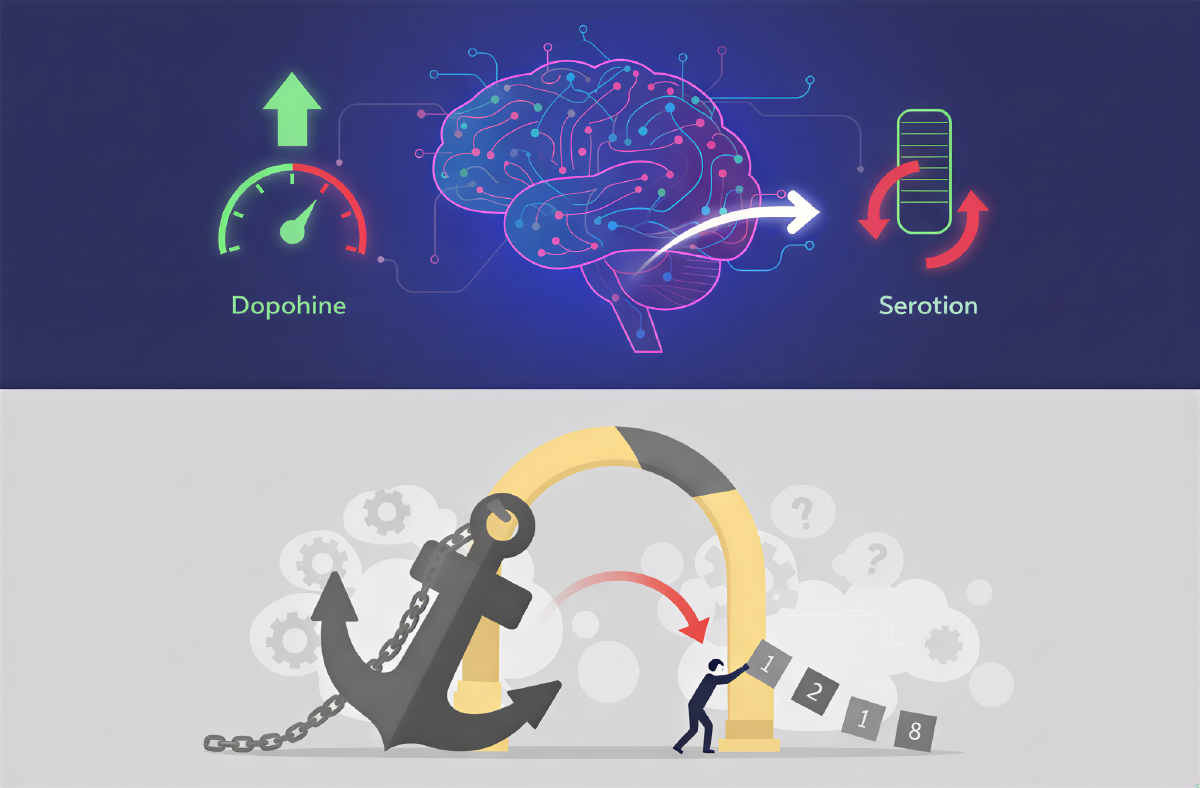
Recent research into neurotransmitter systems has uncovered a sophisticated “gas-brake” mechanism that regulates how we learn from initial information and the weight we accord to subsequent data. This chemical interplay is defined by three primary systems acting in concert. Dopamine, primarily localized in the nucleus accumbens, functions as “The Accelerator”; it signals reward prediction errors and “Go” signals for behavior, effectively encouraging the pursuit of the initial path. Acting in opposition is Serotonin, also within the nucleus accumbens, which serves as “The Brake” by moderating impulses, promoting long-term thinking, and signaling the brain to “Stop” or “Wait.” Finally, GABA (Gamma-Aminobutyric Acid), found in the substantia nigra, acts as “The Internal Governor,” regulating local inhibitory circuits that filter synaptic activity and overall output.
In studies involving reinforcement learning, dopamine signaling spikes when a reward exceeds expectations, creating a strong “Go” signal that anchors the brain to that specific behavior. Conversely, serotonin release in the same region (the nucleus accumbens) often acts in opposition to dopamine, providing a “brake” that allows the brain to evaluate long-term consequences and potentially decouple from an initial, impulsive anchor. This interplay is critical: when the dopamine “gas” is high and the serotonin “brake” is low, individuals are significantly more prone to anchoring and less likely to make the cognitive adjustments necessary for accuracy.
The Psychometric Profile: Individual Differences in Susceptibility#
One of the most compelling aspects of the anchoring effect is its universality, yet recent research has identified significant individual differences in how anchors influence people. These differences are rarely the result of a single trait but rather the interaction between cognitive capacity, thinking styles, and personality.
Intelligence and Cognitive Reflection#
The relationship between intelligence and anchoring is not straightforward. General intelligence, as measured by standard assessments like Raven’s Progressive Matrices, does not inherently insulate an individual from the anchoring effect. Instead, intelligence serves as a moderator that only benefits those already predisposed toward reflective thinking.
The Cognitive Reflection Test (CRT) is the primary tool used to differentiate between “impulsive” thinkers, who rely on rapid System 1 processes, and “reflective” thinkers, who engage in the more demanding System 2 processes. The interaction between these cognitive styles reveals that for Impulsive Thinkers (Low CRT), the correlation between intelligence and anchoring is near zero (r≈0.00), because their intelligence remains irrelevant if they do not initiate the adjustment process in the first place. Conversely, for Reflective Thinkers (High CRT), there is a substantial negative correlation (r≈−0.51); in these cases, high intelligence provides the cognitive “fuel” necessary to successfully carry out the effortful, serial adjustment away from the initial anchor.
This suggests that for intelligence to act as a defensive factor, an individual must first possess the disposition to be reflective. Without the initiation of Type 2 processing, even a knowledgeable person will remain as biased as an impulsive one, falling prey to the automatic activation of anchor-consistent knowledge.
Personality and Mood Dynamics#
Beyond cognitive capacity, personality traits and affective states play a role in anchoring susceptibility.
- Personality: Individuals high in Openness to Experience tend to be less prone to anchoring, likely because they are more willing to consider diverse and contradictory information. Conversely, those high in Agreeableness or Conscientiousness may be more susceptible, as they might subconsciously view the provided anchor as a helpful “hint” or an authoritative standard to be followed.
- Mood: The affective state of the decision-maker is a potent moderator. Research indicates that individuals in a sad mood are more susceptible to anchoring than those in a happy or neutral state. Sadness often prompts a more detail-oriented but less flexible processing style, making it harder to break away from the initial reference point. However, subject-matter expertise can mitigate these mood effects, as experts are more likely to rely on their internal knowledge base rather than their current emotions.
Organizational Frameworks: Anchoring in Negotiation and Strategy#
In the professional world, the anchoring effect is a primary determinant of outcomes in negotiations, financial forecasting, and corporate strategic planning. Organizations are frequently victims of “endowed anchoring,” where last year’s performance or budget becomes the inescapable starting point for all future planning.
Negotiations and the Power of the First Offer#
In negotiations, there is a broad consensus that the party that makes the first offer gains a significant advantage. This first offer “anchors” the discussion and effectively defines the Zone of Possible Agreement (ZOPA). A meta-analysis of negotiation outcomes revealed a correlation of 0.497 between initial offers and outcomes, implying that nearly 50% of the variance in the final price is explained by the initial offer. This advantage becomes decisive in environments of high uncertainty, where the counterparty lacks a clear sense of the asset’s “true” value.
This anchoring strategy manifests across various professional domains with distinct effects. In Salary Negotiations, making the first demand, even if it’s high, can raise the final offer, regardless of subsequent concessions. In Real Estate, using precise list pricing (e.g., listing a house at $255,500 rather than $256,000) attracts higher bids because precision suggests the seller has high-quality, well-calculated information. For B2B Sales, subtle budget questioning, such as asking if a budget is “more or less than $100,000,” sets a high anchor before formal terms are even broached. Finally, in Diplomacy and Labor Relations, making public commitments or pledging a specific budget balance anchors both the negotiator’s own side and the opposing party to that particular goal.
The first offer acts as a filter through which all subsequent information is interpreted: a high anchor draws attention to an item’s positive qualities. In contrast, a low anchor highlights its flaws. To counter this, negotiators are advised to “defuse” the anchor immediately. If a counterpart opens with an unreasonable number, the negotiator must state clearly that the figure is outside the bargaining zone before making a counteroffer. Failing to do so inadvertently validates the anchor’s relevance and allows it to pull the final settlement toward the opponent’s favor.
Financial Markets and Market Inefficiency#
The anchoring effect is a major contributor to financial market inefficiency, particularly through the behavior of sell-side analysts and corporate managers. Analysts frequently use the industry median forecast earnings per share (I-FEPS) as a salient but fundamentally irrelevant anchor for specific firms.
This leads to a systematic bias:
- Analyst Pessimism: Analysts tend to be too pessimistic for firms whose actual earnings should be much higher than the industry norm, as they fail to adjust far enough away from the median.
- Analyst Optimism: Analysts are too optimistic about firms that are underperforming their peers.
- Stock Returns: Because of these biased expectations, high-CAF (Cross-sectional Anchoring in Forecasts) firms experience abnormally high future stock returns once their true profitability is revealed at the earnings announcement.
Managers appear to recognize this bias and engage in strategic behaviors, such as stock splits, to lower their nominal earnings per share, effectively repositioning the firm relative to the industry anchor to avoid analyst pessimism.
Corporate Budgeting and Strategic Planning#
In corporate strategy, anchoring often takes the form of “budgeting inertia”. Managers typically start with last year’s budget and make incremental adjustments, which prevents the dynamic reallocation of resources.
Research on companies in Indonesia found that anchoring bias explains 34% of the variance in financial planning errors. This reliance on historical data persists even when market conditions or technological landscapes have changed dramatically. To overcome this, McKinsey & Company experts recommend “clean-sheet budgeting,” where the starting point is zero rather than the previous year’s figures, and project rankings based on future ROI rather than historical funding.
The Jurisprudence of Heuristics: Anchoring in Legal Systems#
Perhaps the most troubling application of the anchoring effect is found in the legal domain, where sentencing decisions and jury awards, which should be based on objective law and evidence, are often dictated by arbitrary numbers.
Sentencing and Prosecutor Demands#
Experienced trial judges, who often have over 15 years on the bench, are not immune to anchoring. In fact, research shows that the sentence demanded by a prosecutor acts as a powerful anchor. In one study, judges who considered a high demand of 34 months gave sentences nearly 8 months longer than those who believed a 12-month demand for the same crime.
Even more strikingly, this effect persists when the anchor comes from a non-expert or a random source. In another experiment, judges were heavily influenced by sentencing “recommendations” that were ostensibly generated by a computer science student or determined by a roll of dice. This highlights that in the high-pressure environment of the courtroom, even experts use salient numbers to reduce their cognitive load when faced with uncertainty.
Damage Caps and Juror Awards#
The introduction of legal caps on damages, intended to prevent excessive awards, often backfires due to anchoring. These caps provide a salient numerical value that jurors use as a reference point.
- Lifting the Floor: For more minor cases, the existence of a high cap can actually pull awards upward, as jurors anchor to the cap as a measure of what a “serious” injury is worth.
- The Plaintiff’s Demand: In civil litigation, the amount requested by the plaintiff’s attorney serves as a primary anchor. Research consistently shows that higher requests lead to higher awards, provided the request is not so absurd that it loses credibility.
The Digital Frontier: AI-Assisted Decision Making#
The rise of Artificial Intelligence (AI) in professional and personal settings has introduced a new paradigm of “algorithmic anchoring”. AI recommendations, such as risk scores in criminal justice or price suggestions in e-commerce, act as powerful reference points that can skew human judgment.
The Algorithmic Anchor: Automation Bias and the Erosion of Autonomy#
As organizations integrate Artificial Intelligence into high-stakes decision-making, ranging from medical diagnostics to credit lending and parole hearings, a new psychological risk has emerged: The “Human-in-the-loop” Fallacy. While policy-makers often insist that a human must make the final call to ensure ethical oversight, research suggests that once an AI provides an initial “Risk Score” or “Recommendation,” that number becomes a cognitive anchor so heavy that the human “loop” is effectively paralyzed.
The Mechanics of the Digital Anchor#
Algorithmic anchoring differs from human anchoring because of its perceived objectivity**.** When a human colleague suggests a number, we instinctively look for their biases. When a machine produces a “92% Risk Probability,” we treat it as a mathematical certainty. This leads to several systemic issues:
- The “Stickiness” of Risk Scores: In the judicial system, AI tools provide recidivism scores. Even when presented with contradictory evidence (e.g., a defendant’s recent community service or stable employment), judges are statistically less likely to deviate significantly from the AI’s starting number.
- Liability Aversion: For a professional, “overriding” an algorithm creates a personal liability. If a doctor ignores an AI’s high-risk cancer flag and the patient is fine, there is no reward; if they ignore it and the patient is sick, the doctor is blamed. The AI’s output thus becomes the “safe” anchor.
The “Reference Point” in Algorithmic Pricing#
In the consumer world, algorithmic anchoring is used to manipulate perceptions of value**.** Ride-sharing apps and e-commerce platforms don’t just show a price; they show a “suggested” or “typical” price.
- Dynamic Anchoring: By showing a crossed-out “Original Price” calculated by an algorithm to be just high enough to make the “Current Deal” look like a bargain, platforms exploit the Adjustment Heuristic. The user doesn’t evaluate the absolute cost; they assess the “distance” from the anchor.
Ethical Autonomy and the “Baseline” Solution#
To preserve Ethical Autonomy, we must redesign the human-AI collaboration interface. Actual oversight requires “Independent Judgment” protocols.
- The Blind Review: Before seeing the AI’s score, the human expert must record their own independent assessment.
- The Delta Analysis: Systems should be designed to flag not just the AI’s result, but the difference between the human and the machine, forcing a “System 2” reflective process to explain the gap.
Digital Choice Architecture and Nudging#
AI systems act as “choice architects,” strategically designing the environment in which decisions are made to favor specific outcomes through subtle nudges. This architecture leverages several distinct mechanisms to influence user behavior. Strategic Defaults involve preselected options in software, such as retirement plan contribution rates, that exploit human inertia and status quo bias to increase participation without formal mandates. Visual salience uses the availability heuristic by highlighting certain products or prices in different colors or sizes, thereby directing attention and increasing the likelihood of selection.
Furthermore, Personalized Anchors use algorithms to suggest a “starting bid” or “donation amount” based on specific user data, thereby directly employing the anchoring effect to skew users’ perception of “appropriate” spending. Finally, Social Proofing, often seen as “Most users chose X” notifications, serves as a form of social reference point anchoring, encouraging individuals to conform to the “anchor” established by the perceived majority. Through these integrated digital mechanisms, AI systems can profoundly shape decision-making processes within organizational and consumer ecosystems.
Automation Bias and Ethical Autonomy#
A significant risk in human-AI collaboration is “automation bias”, the tendency to favor suggestions from automated systems even when they are incorrect. When an AI provides an initial appraisal or risk assessment, it creates an anchor that is difficult for a human expert to move away from, even if they have superior domain knowledge.
This “algorithmic anchoring” can operate below the threshold of conscious awareness, potentially eroding human autonomy. For instance, social workers using AI to assist in child welfare cases must be wary of “anchoring” on the AI’s initial risk score, which could cause them to ignore subsequent, contradictory evidence that a human-only review would have caught. To mitigate this, practitioners are encouraged to brainstorm independently before consulting AI, thereby establishing an internal “baseline” anchor that is less susceptible to algorithmic distortion.
Systemic Remediation: Strategies for Institutional Accuracy#
Given the robustness and pervasiveness of the anchoring effect, “debiasing” requires more than just awareness; it requires structured, effortful intervention.
“Consider the Opposite” and Mental Mapping#
The most scientifically supported strategy for reducing anchoring is the “consider-the-opposite” technique. This involves a deliberate System 2 process where the individual identifies reasons why the current anchor is inappropriate or why a different value might be correct.
- Mechanism: By forcing the brain to generate “counter-anchor” information, the decision-maker increases the accessibility of non-consistent knowledge, thereby neutralizing the selective accessibility effect.
- Application: In supply chain management or performance appraisals, managers are encouraged to use “mental-mapping” to explicitly list the pros and cons of an anchor value before making a final judgment.
Decision Support Systems (DSS) and Structural Safeguards#
Organizations can build structural safeguards to mitigate anchoring by designing their Decision Support Systems.
- Multiple Assessments: Relying on the “wisdom of the crowd” or multiple independent anchors can dilute the power of any single biased reference point.
- Slowing Down: Accuracy in complex domains like medical diagnosis improves when practitioners are forced to “slow down” and reflect on their initial, anchored impressions.
- Accountability: Knowing that a decision must be justified to a superior or a peer group increases the use of analytical Type 2 processing and reduces reliance on heuristics.
Conclusion: The Strategic Imperative of Cognitive Decoupling#
The architecture of the anchoring effect is a multi-layered construct that defines the boundaries of human rationality. It begins at the synaptic level, where the neurochemical interplay of dopamine and serotonin dictates our sensitivity to initial rewards and prediction errors. It extends to the cognitive level, where the selective accessibility of anchor-consistent knowledge creates a biased mental representation of reality. Finally, it manifests in our social and organizational structures, where first offers in negotiations and historical anchors in budgeting define the trajectory of economic and legal outcomes.
However, the true challenge of the modern era is the institutionalization of anchoring. In a world increasingly dominated by algorithmic guidance and digital choice architecture, anchors are no longer just accidental; they are engineered. The ability to identify, challenge, and decouple from these anchors is no longer just a psychological curiosity; it is a critical skill for leadership resilience.
To transcend the gravitational pull of the initial influence, organizations must move beyond simple awareness. They must build “Cognitive Safeguards”:
- Redefining Leadership: Moving from the “decisive” leader who reacts to first impressions, to the “reflective” leader who demands counter-anchor data.
- Structural Audits: Regularly reviewing “legacy anchors” in budgets and strategic plans to ensure they still serve current market realities.
- Algorithmic Literacy: Ensuring that when AI provides an anchor, human experts have the psychological “space” and procedural permission to disagree.
Ultimately, mastering the anchoring effect is about reclaiming human agency. By fostering a culture of reflective adjustment, we don’t just fix a flaw in thinking; we build high-performing cultures capable of navigating complexity with factual accuracy and ethical autonomy.
References#
- Alomari, M., Al rababa’a, A., El-Nader, G., & Alkhataybeh, A. (2021). Who’s behind the wheel? The role of social and media news in driving the stock–bond correlation. Review of Quantitative Finance and Accounting, 57(3), 959–1007. https://doi.org/10.1007/s11156-021-00967-4
- Binns, R. (2018). Fairness in machine learning: Lessons from political philosophy. In S. A. Friedler & C. Wilson (Eds.), Proceedings of the 1st Conference on Fairness, Accountability and Transparency (Vol. 81, pp. 149–159). PMLR. https://proceedings.mlr.press/v81/binns18a.html
- Bodenhausen, G. V., Gabriel, S., & Lineberger, M. (2000). Sadness and susceptibility to judgmental bias: The case of anchoring. Psychological Science, 11(4), 320–323. https://doi.org/10.1111/1467-9280.00263
- Bystranowski, P., Janik, B., Próchnicki, M., & Skórska, P. (2021). Anchoring effect in legal decision-making: A meta-analysis. Law and Human Behavior, 45(1), 1–23. https://doi.org/10.1037/lhb0000438
- Cen, L., Hilary, G., & Wei, K. C. J. (2013). The role of anchoring bias in the equity market: Evidence from analysts’ earnings forecasts and stock returns. Journal of Financial and Quantitative Analysis, 48(1), 47–76. https://doi.org/10.1017/s0022109012000609
- Chouldechova, A., & Roth, A. (2020). A snapshot of the frontiers of fairness in machine learning. Communications of the ACM, 63(5), 82–89. https://doi.org/10.1145/3376898
- Cools, R., & D’Esposito, M. (2009). Dopaminergic modulation of flexible cognitive control in humans. In L. Iversen, S. Iversen, S. Dunnett, & A. Bjorklund (Eds.), Dopamine handbook (pp. 249–260). Oxford University Press. https://doi.org/10.1093/acprof:oso/9780195373035.003.0017
- DellaVigna, S., & Pope, D. (2018). What motivates effort? Evidence and expert forecasts. The Review of Economic Studies, 85(2), 1029–1069. https://doi.org/10.1093/restud/rdx033
- Furnham, A., & Boo, H. C. (2011). A literature review of the anchoring effect. The Journal of Socio-Economics, 40(1), 35–42. https://doi.org/10.1016/j.socec.2010.10.008
- Gigerenzer, G. (2018). The bias bias in behavioral economics. Review of Behavioral Economics, 5(3-4), 303–336. https://doi.org/10.1561/105.00000092
- Green, B., & Chen, Y. (2019). The principles and limits of algorithm-in-the-loop decision making. Proceedings of the ACM on Human-Computer Interaction, 3(CSCW), Article 50, 1–24. https://doi.org/10.1145/3359152
- Hertwig, R., & Grüne-Yanoff, T. (2017). Nudging and boosting: Steering or empowering good decisions. Perspectives on Psychological Science, 12(6), 973–986. https://doi.org/10.1177/1745691617702496
- Jerez-Fernández, A., Angulo, A. N., & Oppenheimer, D. M. (2014). Show me the numbers: Precision as a cue to others’ confidence. Psychological Science, 25(2), 633–635. https://doi.org/10.1177/0956797613504301
- Jussupow, E., Benbasat, I., & Heinzl, A. (2020). Why are we averse towards algorithms? A comprehensive literature review on algorithm aversion. In F. Rowe (Ed.), Proceedings of the 28th European Conference on Information Systems (ECIS) (Paper RP 168). Association for Information Systems. https://aisel.aisnet.org/ecis2020_rp/168
- Kahneman, D., Rosenfield, A. M., Gandhi, L., & Blaser, T. (2016, October). Noise: How to overcome the high, hidden cost of inconsistent decision making. Harvard Business Review. https://hbr.org/2016/10/noise
- Lee, C.-Y., & Morewedge, C. K. (2022). Noise increases anchoring effects. Psychological Science, 33(1), 60–75. https://doi.org/10.1177/09567976211024254
- Lieder, F., Griffiths, T. L., & Hsu, M. (2018). Overrepresentation of extreme events in decision making reflects rational use of cognitive resources. Psychological Review, 125(1), 1–32. https://doi.org/10.1037/rev0000074
- Logg, J. M., Minson, J. A., & Moore, D. A. (2019). Algorithm appreciation: People prefer algorithmic to human judgment. Organizational Behavior and Human Decision Processes, 151, 90–103. https://doi.org/10.1016/j.obhdp.2018.12.005
- Melnikoff, D. E., & Bargh, J. A. (2018). The mythical number two. Trends in Cognitive Sciences, 22(4), 280–293. https://doi.org/10.1016/j.tics.2018.02.001
- Middleman, R. R., & Wood, G. G. (1991). Seeing/believing/seeing: Perception-correcting and cognitive skills. Social Work, 36(3), 243–246. https://doi.org/10.1093/sw/36.3.243
- Mussweiler, T., & Strack, F. (2001). The semantics of anchoring. Organizational Behavior and Human Decision Processes, 86(2), 234–255. https://doi.org/10.1006/obhd.2001.2954
- Rachlinski, J. J., & Wistrich, A. J. (2017). Judging the judiciary by the numbers: Empirical research on judges. Annual Review of Law and Social Science, 13(1), 203–229. https://doi.org/10.1146/annurev-lawsocsci-110615-085032
- Schultz, W. (2016). Dopamine reward prediction error coding. Dialogues in Clinical Neuroscience, 18(1), 23–32. https://doi.org/10.31887/dcns.2016.18.1/wschultz
- Seymour, B., & McClure, S. M. (2008). Anchors, scales and the relative coding of value in the brain. Current Opinion in Neurobiology, 18(2), 173–178. https://doi.org/10.1016/j.conb.2008.07.010
- Simmons, J. P., LeBoeuf, R. A., & Nelson, L. D. (2010). The effect of accuracy motivation on anchoring and adjustment: Do people adjust from provided anchors? Journal of Personality and Social Psychology, 99(6), 917–932. https://doi.org/10.1037/a0021540
- Szaszi, B., Palinkas, A., Palfi, B., Szollosi, A., & Aczel, B. (2018). A systematic scoping review of the choice architecture movement: Toward understanding when and why nudges work. Journal of Behavioral Decision Making, 31(3), 355–366. https://doi.org/10.1002/bdm.2035
- Tamir, D. I., & Mitchell, J. P. (2013). Anchoring and adjustment during social inferences. Journal of Experimental Psychology: General, 142(1), 151–162. https://doi.org/10.1037/a0028232
- Thomas, M., & Morwitz, V. G. (2009). The ease-of-computation effect: The interplay of metacognitive experiences and naive theories in judgments of price differences. Journal of Marketing Research, 46(1), 81–91. https://doi.org/10.1509/jmkr.46.1.81
- Urban, K., & Urban, M. (2021). Anchoring effect of performance feedback on accuracy of metacognitive monitoring in preschool children. Europe’s Journal of Psychology, 17(1), 104–118. https://doi.org/10.5964/ejop.2397
- Vese, D. (2022). Nudge: The final edition edited by Richard H Thaler and Cass R Sunstein, London: Allen Lane, Penguin, 2021, edition final, xiv + 366 pp. European Journal of Risk Regulation, 13(2), 350–355. https://doi.org/10.1017/err.2021.61
- Weber, E. U. (2013). Seeing is believing. Nature Climate Change, 3(4), 312–313. https://doi.org/10.1038/nclimate1859
- Xiong, C., Stokes, C., Kim, Y.-S., & Franconeri, S. (2023). Seeing what you believe or believing what you see? Belief biases correlation estimation. IEEE Transactions on Visualization and Computer Graphics, 29(1), 493–503. https://doi.org/10.1109/TVCG.2022.3209405
- Yang, C., Sun, B., & Shanks, D. R. (2018). The anchoring effect in metamemory monitoring. Memory & Cognition, 46(3), 384–397. https://doi.org/10.3758/s13421-017-0772-6
- Yang, Z. (2025). The role of social media in shaping public opinion in financial markets and its impact. Highlights in Business, Economics and Management, 48, 78–83. https://doi.org/10.54097/ns3pz962
- Zwaan, R. A., Etz, A., Lucas, R. E., & Donnellan, M. B. (2018). Making replication mainstream. Behavioral and Brain Sciences, 41, Article e120. https://doi.org/10.1017/s0140525x17001972