Introduction#
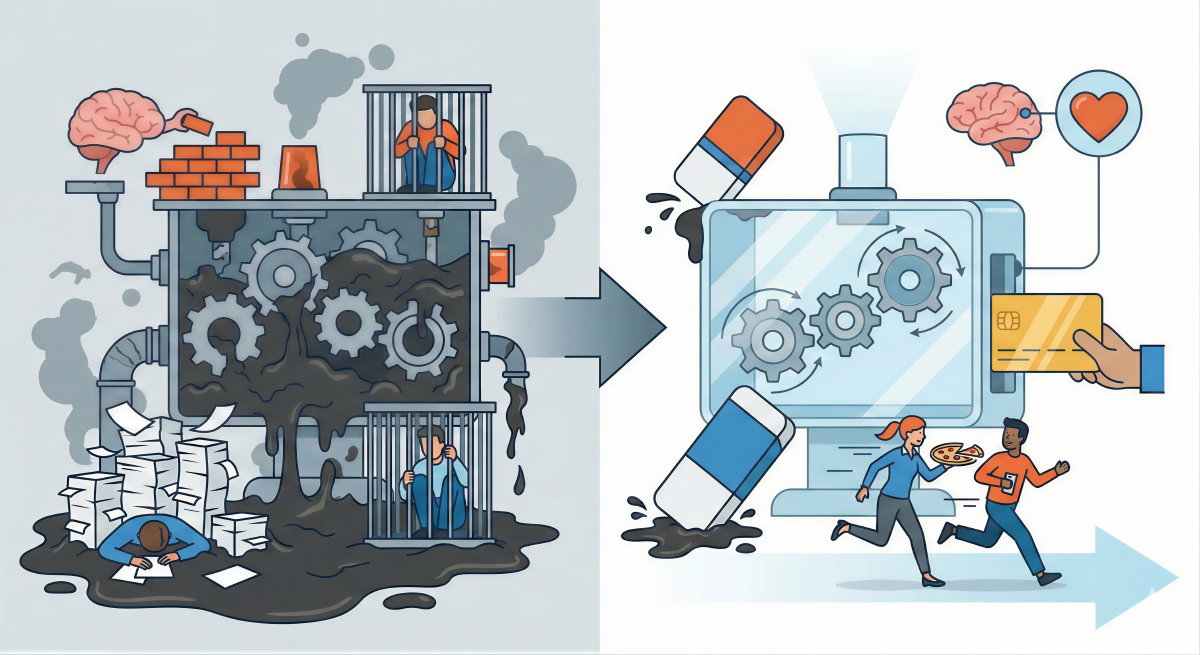
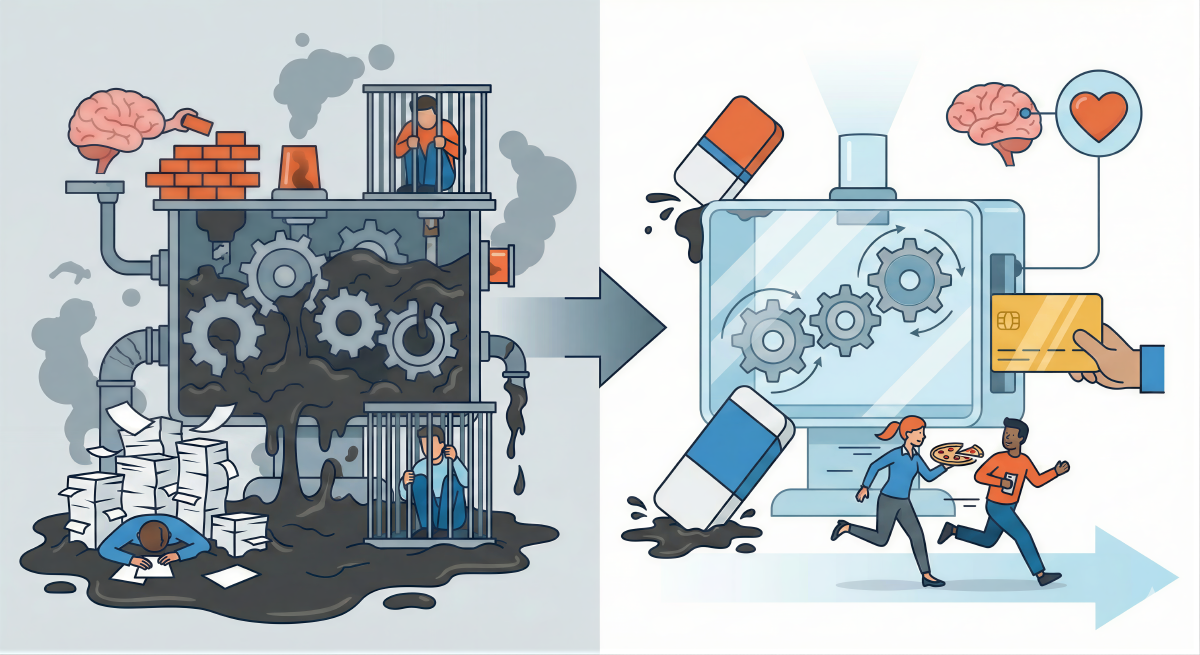
In the contemporary discourse of organizational efficiency, a troubling paradox has emerged: despite the proliferation of digital tools designed to accelerate communication and automate execution, productivity growth has decelerated. The modern enterprise often finds itself mired in a “gelatinous substance” of redundant approvals, opaque compliance mandates, and cognitive overload, a phenomenon known in behavioral economics as “sludge” and in management theory as “procedural friction.” Unlike the benevolent “nudge” that facilitates better decisions, sludge acts as a malevolent twin, increasing the effort, time, and psychological cost required to navigate a system. This friction is the silent killer of productivity, acting as a cumulative, microscopic tax on human agency that disproportionately affects those with limited cognitive bandwidth. As organizations scale, they accumulate “organizational drag,” a form of institutional entropy that drains time, talent, and energy, often resulting in a surplus of obstacles where the friction of initiating a project exceeds its perceived value.
This article, The Architecture of Obstacles, confronts this central dilemma through an interdisciplinary synthesis of behavioral economics, systems theory, and management science. It examines how friction is not merely a byproduct of incompetence, but often a functional design, a rationing mechanism that filters out the less persistent or resourceful. The decay of efficient workflows is further illuminated through the lens of the Second Law of Thermodynamics, which states that organizational systems naturally trend toward disorder unless deliberate energy is applied to pruning and simplification. Beyond structural decay, procedural friction imposes a crippling extraneous cognitive load, consuming executive function and disrupting the “flow state” essential for high-value work. Such environments frequently engender “learned helplessness,” a conditioned passivity in which employees cease improvement attempts after repeated encounters with rigid, non-contingent systems.
To move from diagnosis to resolution, this article equips leaders with a rigorous diagnostic toolkit that makes the invisible visible. Methodologies such as Sludge Audits, Process Mining, Organizational Network Analysis, and the Standard Cost Model enable the quantification and monetization of hidden burdens. Furthermore, the article champions a fundamental shift in mindset: from an instinctual “add-first” heuristic to a deliberate “Science of Subtraction.” By showcasing pioneering models, from Haier’s radical Rendanheyi structure and Netflix’s culture of context over control to innovative “Gold Card” regulatory exemptions, it provides a strategic blueprint for dismantling obstacles. Ultimately, this work argues that reclaiming efficiency and unlocking human ingenuity require not more technology but the deliberate, evidence-based removal of barriers. The frictionless enterprise is not merely an operational ideal, but an imperative for sustainable performance and organizational vitality in the twenty-first century.
The Theoretical Anatomy of Friction#
“Procedural friction” is the silent killer of productivity, acting not through a dramatic cessation of operations, but through a cumulative, microscopic tax on human agency. Unlike a total system failure, which demands immediate intervention, friction manifests as a slow-onset paralysis where the effort required to initiate action gradually eclipses the value of the outcome itself.
To understand this phenomenon requires a rigorous dissection of its theoretical underpinnings, distinguishing the necessary governance, the guardrails that ensure safety, ethics, and strategic alignment, from the pathological accumulation of speed bumps. These “speed bumps” are often the structural remnants of past crises or ego-driven redundancies that have calcified into institutional norms. This accumulation effectively drains the organization’s cognitive surplus, leaving its most talented members mired in low-value administrative labor, ultimately leading to institutional entropy.
The Concept of Sludge: Behavioral Economics and the Dark Side of Nudging#
The intellectual lineage of procedural friction can be traced most directly to the work of Nobel laureate Richard Thaler and legal scholar Cass Sunstein. In their seminal exploration of choice architecture, they introduced the concept of the “nudge”, a design feature that alters people’s behavior predictably without forbidding any options or significantly changing their economic incentives. If a nudge is the benevolent application of behavioral science to facilitate better decisions, “sludge” is its malevolent twin. As defined by Thaler and Sunstein, sludge consists of frictions that make wise choices more difficult or impede individuals’ access to goods, services, or rights to which they are entitled.
Sludge is not merely a byproduct of incompetence; it is a functional friction. It encompasses an exhaustive taxonomy of impediments: complex forms, hidden fees, manipulative defaults, and excessive waiting periods. These frictions increase the effort, time, and psychological cost required to complete a task. While often attributed to bureaucratic inertia, sludge can be intentional, a mechanism designed by private firms or public agencies to dissuade users from claiming rebates, cancelling subscriptions, or accessing government benefits. The friction serves as a rationing device, filtering out those with limited time, patience, or cognitive bandwidth.
Sunstein’s theoretical framework for sludge emphasizes the distinction between “compliance costs” and “learning costs.” Compliance costs are the tangible burdens of executing the process, the hours spent filling out forms or standing in queues. Learning costs, often more insidious, are the cognitive investments required to understand how to navigate the system. When information is opaque, dispersed, or written in specialized jargon, the “knowledge of how to get things done” becomes a barrier to entry. This creates a “time tax” that is regressive, disproportionately affecting those who can least afford the cost of executive function.
Organizational Drag: The Entropy of Scale#
While sludge often refers to the interface between an individual and an institution, “organizational drag” refers to the internal friction that accumulates within a company as it scales. Research by Michael Mankins at Bain & Company provides a robust framework for understanding this phenomenon. Mankins defines organizational drag as the collection of institutional factors that slow operations, decrease output, and drain employee energy. It is the managerial equivalent of entropy, a tendency for systems to move from order and speed toward disorder and stasis.
The study of organizational drag reveals that it is not a lack of talent that hampers large organizations, but a surplus of obstacles. As companies grow, they implement processes to manage complexity and mitigate risk. However, these processes often outlive their utility. The “matrix” structure, designed to ensure cross-functional alignment, usually devolves into a mechanism for gridlock, where every decision requires the consensus of multiple stakeholders who have the power to veto but not the power to authorize.
Mankins identifies three distinct casualties of this drag: time, talent, and energy.
- Time: The quantifiable hours lost to low-value interactions, such as redundant meetings and e-mail chains.
- Talent: The misallocation of high-performers to bureaucratic maintenance rather than strategic innovation.
- Energy: The elusive but critical morale of the workforce. When employees spend more time navigating internal politics than serving customers, engagement plummets.
This creates a “surplus of obstacles” where the friction involved in initiating a new project exceeds the perceived value of the outcome. The result is organizational inertia, where the safest course of action is to remain in stasis.
The Physics of Bureaucracy: Entropy and Cybernetics#
To understand why friction accumulates so relentlessly, we must look at the laws of physics and systems theory. Organizational Entropy is a concept derived from the Second Law of Thermodynamics, which states that in a closed system, disorder (entropy) always increases over time unless energy is intentionally applied to maintain order. In an organizational context, “order” refers to aligning resources and workflows toward a goal. Without constant “negative entropy” (energy input in the form of simplification, clarification, and pruning), processes naturally degrade into chaos, redundancy, and complexity.
Cybernetic Control Systems accelerate this decay. Organizations are networks of feedback loops designed to regulate behavior. However, these loops often suffer from time delays and signal distortion. When a failure occurs (e.g., a budget overrun), the system adds a control (a new approval step). Because there is a delay between implementing the control and observing its cost (slowness), the system often overcorrects. This leads to oscillations, where organizations swing wildly between centralization (high friction) and decentralization (chaos), never finding a stable equilibrium. The bureaucracy grows because the feedback loop for “adding a rule” is fast (immediate feeling of safety), while the feedback loop for “process drag” is slow and cumulative.
Parkinson’s Law and the Mathematics of Expansion#
The growth of administrative friction is also predicted mathematically by Parkinson’s Law, which famously states that “work expands to fill the time available for its completion.” Less famously, C. Northcote Parkinson posited a corollary regarding the growth of bureaucracy: “Officials make work for each other.” He observed that the number of employed officials in a bureaucracy rose by 5-7% per year, regardless of variations in the amount of work to be done.
This occurs due to two forces:
- The Law of Multiplication of Subordinates: An official who feels overworked will always seek to hire two subordinates rather than share the work with a rival colleague.
- The Law of Multiplication of Work: These two subordinates must now generate work for each other (memos, approvals, supervision) to justify their existence, creating a closed loop of administrative activity that produces no external value.
Cognitive Load Theory and the Scarcity of Bandwidth#
Procedural friction imposes a high “extraneous cognitive load.” This is the mental effort required to process the task’s mechanism rather than its substance. When a workflow is laden with unnecessary steps, inconsistent interfaces, or ambiguous instructions, the brain must divert bandwidth to deciphering the environment. In software engineering and knowledge work, this phenomenon is known as “cognitive friction”, the resistance encountered by a human intellect when engaging with a complex system.
Unlike mechanical friction, which generates heat, cognitive friction consumes executive function. It disrupts the “flow state”, the psychological state of optimal performance in which high-value work occurs. When an engineer is forced to context-switch between coding and navigating a labyrinthine compliance portal, the cost is not just the time spent in the portal; it is the “resumption lag” required to reload the complex mental models of the code into working memory. Sustained cognitive friction leads to decision fatigue, information overload, and eventually burnout.
The Psychology of Helplessness and Risk Aversion#
Deep-seated psychological mechanisms sustain the persistence of friction. Martin Seligman’s concept of Learned Helplessness is critical here. Seligman observed that when subjects are repeatedly exposed to adverse stimuli they cannot control, they eventually cease trying to escape, even when an exit becomes available. In bureaucratic environments, this manifests when employees, after repeated attempts to streamline a process, are thwarted by rigid policies and stop suggesting improvements. They learn that the outcome (efficiency) is independent of their behavior (innovation). This passivity is not laziness; it is a conditioned response to a non-contingent environment.
Organizational Risk Aversion often mirrors this helplessness. Bureaucracies are structurally designed to minimize Type I errors (actions that cause harm) while ignoring Type II errors (failure to act). A manager who approves a project that fails faces censure; a manager who blocks a project that might have succeeded faces no consequences. This asymmetry incentivizes the addition of friction, more signatures, more reviews, and more committees as a defense mechanism. It creates an “illusion of control,” in which the accumulation of paperwork is mistaken for risk mitigation.
The Diagnostic Toolkit - Seeing the Invisible#
Friction is often invisible to those trapped inside it. It normalizes into “the way things are done.” To combat it, organizations must employ rigorous diagnostic methodologies that can visualize, quantify, and root out the speed bumps. These tools range from qualitative behavioral audits to advanced algorithmic X-rays of digital workflows.
The Sludge Audit: A Behavioral Microscope#
The Sludge Audit is a structured methodology for identifying and measuring friction in user journeys. Pioneered by government units like the New South Wales (NSW) Behavioural Insights Unit and championed by the OECD, the sludge audit shifts the focus from “process compliance” to “user experience”.
Methodology of a Comprehensive Sludge Audit:
- Scope Definition and User Selection: The audit begins by defining the specific service or process under review (e.g., “Applying for Disability Benefits” or “Vendor Onboarding”). Crucially, it identifies the user persona and acknowledges that friction affects different groups (e.g., native vs. non-native speakers).
- Behavioral Journey Mapping: Unlike traditional process mapping, which focuses on system steps, behavioral mapping captures every granular action the user must take. This includes the “micro-frictions” often invisible to administrators: finding the correct URL, resetting a password, printing a form, finding a notary, or waiting on hold.
- Friction Taxonomy and Quantification: Each step is analyzed against specific friction categories:
- Search Costs: The time and effort to find information.
- Decision Costs: The cognitive load of choosing between complex options.
- Compliance Costs: The actual time and financial cost (postage, fees) of execution.
- Emotional Costs: The psychological burden, including stigma, frustration, and loss of autonomy.
- Metric Calculation: The audit assigns quantitative values to these steps using the “Sludge Scales,” estimating the total “Time to Complete” and “Effort Score.”
- Impact Analysis: The final step assesses the equity impact. Does this sludge disproportionately deter vulnerable populations?
This method provides a “ground-level” view of friction, revealing obstacles that look like minor details on a flowchart but feel like insurmountable walls to a user.
Process Mining: The Digital Truth#
While sludge audits are qualitative and user-centric, Process Mining offers a quantitative, data-driven approach. It bridges the gap between Data Science and Business Process Management (BPM) by leveraging the digital footprints left by every transaction in an organization’s IT systems (e.g., ERP, CRM, EHR).
Process mining differs fundamentally from traditional process mapping. Traditional mapping describes how the process should proceed (the “Happy Path”); process mining reveals how it unfolds, including deviations, loops, and bottlenecks.
Key Algorithms and Diagnostic Visualizations:
- The Dotted Chart: This visualization plots every event for every case over time. It allows analysts to see the “rhythm” of the process. Vertical lines indicate batch processing; gaps indicate bottlenecks or waiting times. It provides an immediate visual diagnostic of performance spectrums.
- Trace Alignment: This sophisticated technique aligns the event logs of multiple process instances (traces) to a reference model or to each other. By aligning the traces, algorithms can detect patterns of deviation. For example, if 40% of traces show a specific step being skipped or repeated, Trace Alignment highlights this anomaly. It is akin to DNA sequence alignment in biology, treating the process workflow as a genetic code to be analyzed for mutations.
- Social Network Analysis: Process mining can also derive the “handover of work” social network, revealing which individuals or departments are the central nodes of friction (bottlenecks) and which are isolated.
The power of process mining lies in its objectivity. It does not rely on interviews or memory; it depends on the timestamped reality of the server logs.
Organizational Network Analysis (ONA): Mapping Invisible Friction#
While process mining looks at transactional logs, Organizational Network Analysis (ONA) visualizes the human relationships and information flows that drive work. It reveals the “informal organization” that exists beneath the official org chart.
ONA creates a graph with nodes representing employees and edges representing interactions (e.g., “Who do you go to for advice?”, “Who do you need approval from?”). This analysis is critical for identifying Collaborative Friction:
- Bottlenecks: Individuals who are central to too many information flows. If 50 people rely on a single manager for approval, that manager is a single point of failure and a source of massive delays.
- Silos: Clusters of nodes that have few connections to other groups, indicating high friction in cross-functional collaboration.
- Overloaded Nodes: Employees who are “bridging” too many structural holes, leading to burnout and slowed decision-making.
By analyzing email metadata (digital exhaust) or survey data, ONA can pinpoint precisely where the human network is gridlocked, often revealing that the source of delay is not a “process step” but an overwhelmed individual.
Value Stream Mapping (VSM) vs. Process Mining#
Value Stream Mapping (VSM) is a legacy tool from Lean manufacturing that remains vital for analyzing physical and cross-functional flows. Unlike process mining, which is automated, VSM is a collaborative workshop activity.
| Feature | Value Stream Mapping (VSM) | Process Mining |
|---|---|---|
| Data Source | Manual observations, sticky notes, and interviews | Event logs from IT systems (SAP, Salesforce, etc.) |
| Perspective | “Snapshot” of a specific time | Continuous, longitudinal analysis of the entire history |
| Scope | Physical & Information flow (holistic) | Digital flow (specific to systems) |
| Strength | Builds team consensus; visualizes physical waste | Handles massive complexity; objective data; identifies variants |
| Weakness | Subjective; time-consuming; misses digital nuances | Requires clean data; misses offline interactions |
VSM is particularly effective for identifying “white space” friction, the delays that occur between departments where no digital log is generated (e.g., a file sitting on a desk).
The Standard Cost Model (SCM): Monetizing the Burden#
To drive change, friction must often be translated into financial terms. The Standard Cost Model (SCM) is the globally accepted methodology for quantifying the economic cost of administrative burdens. Initially developed in the Netherlands, it has been adopted by the OECD and the European Commission.
The core of the SCM is a simple but powerful formula:
Administrative Cost = Price (\times) Time (\times) Quantity (Population (\times) Frequency)
Where:
- Price: The hourly labor cost of the individual performing the task (including overhead).
- Time: The time required to perform the administrative activity once.
- Quantity: The frequency of the activity multiplied by the size of the population affected.
Application Example:
Consider a requirement for nurses to fill out a compliance form.
- Price: $50/hour.
- Time: 20 minutes (0.33 hours).
- Quantity: 10,000 nurses filing the form weekly (52 times/year) = 520,000 instances.
Total Cost = $50 (\times) 0.33 (\times) 520.000 = $8.580.000 {annually}.
This formula allows organizations to calculate the ROI of friction reduction. If the form can be simplified to take 10 minutes, the savings are over $4 million annually. The SCM makes the “invisible” cost of time visible on the balance sheet.
The Economics of Obstacles - The Cost of Inaction#
The aggregate cost of procedural friction is not merely an annoyance; it is a macroeconomic drag that stifles growth, exacerbates inequality, and burns out the workforce. The data reveals a staggering toll.
The Macroeconomic “Time Tax.”#
At the national level, administrative red tape acts as a brake on GDP growth. A 2025 report by the Competitive Enterprise Institute highlights that federal regulations in the U.S. impose an annual economic impact of approximately $2.155 trillion, roughly 7% of the U.S. GDP. This “hidden tax” is embedded in the cost of every product and service, thereby reducing households’ purchasing power and firms’ investment capacity.
Comparative analysis by the Ifo Institute suggests that this relationship is causal. Their international study found that a fundamental reduction in bureaucracy is associated with an average 4.6% increase in real GDP per capita. In Germany, the failure to reduce bureaucratic costs resulted in an estimated €193 billion in direct administrative costs alone. This “deadweight loss” represents resources consumed not in creating value but in proving compliance.
The Healthcare Crisis: Burnout by Bureaucracy#
Nowhere is friction more palpable, or more dangerous, than in healthcare. The sector serves as a grim case study in what happens when administrative burdens overwhelm professional capacity.
- Physician Burnout: Research correlates the rise in physician burnout (reaching 54% in some studies) directly with the increased administrative burden of Electronic Health Records (EHRs). Physicians spend hours in “pajama time”, logging data after clinic hours.
- The Cost of Complexity: It is estimated that over one-third of all healthcare costs in the U.S. are administrative. This includes the army of staff required to navigate the “sludge” of billing, coding, and insurance prior authorizations.
- Prior Authorization Friction: A 2024 AMA survey revealed that 94% of physicians report delays in care due to prior authorization, with 78% reporting that patients abandoned treatment entirely due to the administrative hurdles. The cost to a practice to process these authorizations is approximately $6 per transaction, a massive cumulative drain on the system.
The Ivory Tower Paradox: Administrative Bloat in Higher Education#
A striking example of Parkinson’s Law in action is the phenomenon of Administrative Bloat in higher education. Over the last three decades, while student enrollment and faculty numbers have grown steadily, the number of administrative positions has exploded exponentially.
- The Data: Between 1993 and 2007, the number of full-time administrators per 100 students at America’s leading universities grew by 39%, while teaching and research staff grew by only 18%. At some institutions, like Arizona State University, the number of administrators per 100 students increased by 94%.
- The Driver: This growth is not driven by educational needs but by “compliance creep” and the expansion of non-academic services (student affairs, diversity offices, sustainability coordinators). Each new office generates new policies, which require new forms, which require new staff to process.
- The Cost: This friction is directly passed to students in the form of tuition hikes, contributing to the student debt crisis. It is a closed loop of administrative self-preservation where the “business” of the university consumes the resources meant for the “mission” of the university.
The Digital Poorhouse: Inequality of Friction#
Procedural friction is not evenly distributed. It follows a gradient of power. Virginia Eubanks, in her analysis of Automating Inequality, describes how automated decision systems in welfare and housing create a “Digital Poorhouse”.
- The Rationing Function: For people with low incomes, friction is a gatekeeper. Complex forms, rigid eligibility algorithms, and “techno-solutionist” identity verification systems act as barriers that filter out the most vulnerable, those who lack the stability, time, or cognitive surplus to navigate the maze.
- Scarcity Mindset: Behavioral science shows that poverty imposes a “bandwidth tax.” The constant cognitive load of managing scarcity reduces fluid intelligence. When sludge is added to this load, it pushes individuals to the brink of failure. A wealthy person outsources the sludge (hiring an accountant); a poor person must navigate it alone with depleted cognitive resources.
Strategies for Elimination - The Science of Subtraction#
Diagnosing friction is only the preamble. The true challenge lies in excision. Successful organizations do not merely manage friction; they declare war on it. This requires a fundamental shift in mindset from “addition” to “subtraction,” and the implementation of radical structural models.
The Science of Subtraction: Overcoming the Add-First Heuristic#
Why do we add red tape? Leidy Klotz, author of Subtract, identifies a deep-seated cognitive bias: the “Add-First” Heuristic. In a series of experiments, ranging from stabilizing a Lego bridge to improving a travel itinerary, Klotz found that human beings overwhelmingly default to adding elements to solve a problem, even when subtracting elements is more efficient.
- The Lego Experiment: Participants were asked to stabilize a Lego structure. They could either add bricks (costing money) or remove a brick (free). The vast majority added bricks. Only when explicitly prompted (“You can subtract bricks”) did they consider the efficient solution.
- Organizational Implication: When a process fails (e.g., a fraud incident), the manager’s instinct is to add a control. To subtract a control requires “counter-intuitive” cognitive effort. It requires imagining a state that is less than the status quo.
Implementing Subtraction:
To overcome this, organizations must gamify subtraction.
- “Minus-One” Rules: Mandate that for every new form added, two must be removed.
- Stop-Doing Lists: Strategic planning must include a “Stop-Doing” session where low-value activities are formally deprecated.
Haier: The Rendanheyi Model - Zero Distance#
The most radical experiment in friction removal is the Rendanheyi model, pioneered by Haier CEO Zhang Ruimin. Recognizing that middle management was a primary source of friction (separating employees from customers), Haier dismantled its hierarchy.
Mechanism of the Model:
- Zero Distance: The goal is to eliminate the distance between the employee and the user.
- Micro-Enterprises (MEs): Haier broke its 80,000-person behemoth into 4,000+ autonomous MEs. Each ME is a small team (10-15 people) that operates like a startup.
- The Three Powers: Bureaucracy is bypassed by delegating three critical powers to the ME:
- Strategy: They decide what to build based on user orders (Dan).
- Hiring: They hire their own talent without HR approval.
- Distribution: They set their own pay based on the value they create.
Netflix: Context, Not Control#
Netflix attacks friction through culture rather than structure. Their “Freedom and Responsibility” philosophy is built on the premise that “process creep” drives away talent. They maximize “talent density” and then remove the controls that average employees require.
Specific Interventions:
- Vacation Policy: They realized tracking vacation was an industrial-era relic. They abolished the policy. The rule is “Take a vacation.” This removes the administrative cost of tracking and the psychological friction of asking permission.
- Expense Policy: Replaced a thick compliance manual with five words: “Act in Netflix’s best interest.” This shifts the cognitive load from compliance to judgment. It assumes trust.
Amazon: Two-Pizza Teams and the API Mandate#
Amazon tackles the friction of coordination. According to the “Ringelmann Effect,” individual productivity decreases as group size increases due to social loafing and coordination costs.
The Two-Pizza Rule:
Jeff Bezos mandated that no team should be larger than what two pizzas can feed (6-10 people).
- Decoupled Architecture: These teams interact via “Service Oriented Architecture” (APIs). Team A does not need to meet with Team B to get the data; they can call Team B’s API. This replaces the “social friction” of meetings with the “technical friction” of code, which is far more scalable.
AstraZeneca: The Simplification Campaign#
Facing a patent cliff, AstraZeneca realized that its scientists were spending too much time on administration. They launched a top-down simplification program.
- The Audit: They analyzed the “time tax” on researchers.
- The Cull: They reduced the number of decision-making committees and simplified the approval hierarchy.
- The Outcome: This represents the “Incumbent’s Path”, using centralized authority to clear the sludge that accumulates naturally over time.
The “Gold Card” Standard: Regulatory Exemptions#
A powerful new model for reducing friction in high-stakes environments is the “Gold Card” system, recently pioneered in Texas healthcare legislation (HB 3459).
- The Mechanism: This law allows physicians who have a high approval rate (e.g., 90%) for prior authorization requests to earn an exemption from the process. They are “gold carded,” bypassing the administrative friction entirely.
- The Logic: This shifts the system from “guilty until proven innocent” (universal friction) to “earned trust” (targeted friction). It dramatically reduces the administrative burden on high-performing providers while maintaining oversight for outliers. This model is now being replicated across other states and industries to incentivize quality while reducing sludge.
Gamification of Dynamics: The Beer Game#
To help teams understand the systemic causes of friction, organizations are increasingly turning to simulations like The Beer Game. Originally developed at MIT in the 1960s, this game simulates a supply chain (Retailer, Wholesaler, Distributor, Factory).
- The Lesson: Players consistently experience the “Bullwhip Effect,” where small fluctuations in customer demand create massive oscillations and backlogs upstream. They learn that friction (delays in information and material flow), combined with rational individual decisions, leads to systemic failure.
- The Application: By playing the game, managers viscerally understand how time delays (a form of friction) destabilize systems. It teaches them that adding more “control” (ordering more) often makes the oscillation worse, and that the only solution is to reduce communication friction (transparency) and shorten feedback loops.
AI and Algorithmic Accountability#
The frontier of friction reduction is Algorithmic, but it comes with new risks.
- Predictive Process Monitoring: AI tools can now sit on top of process mining logs and predict a bottleneck before it happens.
- The Human-in-the-Loop Cost: While AI reduces friction, maintaining a “human in the loop” to review AI decisions reintroduces friction. This creates a tension between Efficiency (automated decisions) and Accuracy (human review). If humans rubber-stamp the AI to save time (Automation Bias), the friction reduction is illusory and dangerous. Proper optimization requires balancing the cost of False Positives (stopping a good process) against the cost of False Negatives (allowing a bad one).
Conclusion - The Frictionless Imperative#
Procedural friction is not a trivial nuisance; it is a systemic pathology that threatens the economic viability of nations and the mental health of workers. It is the “sand” that destroys the gears of the modern enterprise.
The analysis reveals that friction is resilient because it is protected by human psychology (the add-first heuristic, risk aversion), physical laws (entropy), and organizational dynamics (Parkinson’s Law). Defeating it requires more than good intentions; it requires a new toolkit.
- Diagnostically, organizations must move from intuition to evidence, utilizing Sludge Audits, Process Mining, Organizational Network Analysis, and the Standard Cost Model to make the invisible visible.
- Structurally, they must experiment with radical decentralization (Haier), autonomous units (Amazon), and “Gold Card” exemptions that reward competence with speed.
- Psychologically, leaders must cultivate a Subtraction Mindset, celebrating the removal of a rule as a greater triumph than the creation of a new one.
In an era of increasing complexity, the organizations that thrive will not be those that add more technology, but those that successfully subtract the barriers to human ingenuity. The silent killer can be silenced, but only by a deliberate, relentless, and scientific pursuit of simplicity.
References#
- Aldous, D. (2023). Noise: A flaw in human judgment by Daniel Kahneman, Olivier Sibony, and Cass R. Sunstein: Little, Brown Spark, 2021, 464 pp., US$ 32.00. The Mathematical Intelligencer, 45(3), 291–293. https://doi.org/10.1007/s00283-022-10207-9
- Benartzi, S., Beshears, J., Milkman, K. L., Sunstein, C. R., Thaler, R. H., Shankar, M., Tucker-Ray, W., Congdon, W. J., & Galing, S. (2017). Should governments invest more in nudging? Psychological Science, 28(8), 1041–1055. https://doi.org/10.1177/0956797617702501
- Birnbaum, R. (2005). The innovator’s dilemma: When new technologies cause great firms to fail [Review of the books The innovator’s dilemma: When new technologies cause great firms to fail, by C. M. Christensen, and The innovator’s solution: Creating and sustaining successful growth, by C. M. Christensen & M. E. Raynor]. Academe, 91(1), 80–84. https://doi.org/10.2307/40252749
- Boudreau, K. J., & Lakhani, K. R. (2013). Using the crowd as an innovation partner. Harvard Business Review, 91(4), 60–69, 140.
- Davenport, T. H., & Ronanki, R. (2018). Artificial intelligence for the real world. Harvard Business Review, 96(1), 108–116.
- DeHart-Davis, L. (2017). Creating effective rules in public sector organizations. Georgetown University Press.
- Edmondson, A. C. (2018). The fearless organization: Creating psychological safety in the workplace for learning, innovation, and growth. John Wiley & Sons.
- Frynas, J. G., Mol, M. J., & Mellahi, K. (2018). Management innovation made in China: Haier’s Rendanheyi. California Management Review, 61(1), 71–93. https://doi.org/10.1177/0008125618790244
- Garcia, C. de L., de Abreu, L. C. de, Ramos, J. L. S., de Castro, C. F. D., Smiderle, F. R. N., dos Santos, J. A., & Bezerra, I. M. P. (2019). Influence of burnout on patient safety: Systematic review and meta-analysis. Medicina, 55(9), Article 553. https://doi.org/10.3390/medicina55090553
- Gawande, A. (2011). The checklist manifesto: How to get things right. Picador.
- Gino, F., & Staats, B. (2015, November). Why organizations don’t learn: Our traditional obsessions—success, taking action, fitting in, and relying on experts—undermine continuous improvement. Harvard Business Review, 93(11), 110–118.
- Gordon, F. (2019). Virginia Eubanks (2018) automating inequality: How high-tech tools profile, police, and punish the poor. New York: Picador, St Martin’s Press. Law, Technology and Humans, 162–164. https://doi.org/10.5204/lthj.v1i0.1386
- Hamel, G., & Zanini, M. (2020). Humanocracy: Creating organizations as amazing as the people inside them. Harvard Business Review Press.
- Hastie, R., & Dawes, R. M. (2010). Rational choice in an uncertain world: The psychology of judgment and decision making (2nd ed.). Sage Publications.
- Kanter, R. M., & Dai, N. H. (2018). Haier: Incubating entrepreneurs in a Chinese giant (Case 318-104). Harvard Business School.
- Klotz, L. (2021). Subtract: The untapped science of less. Flatiron Books.
- Majumdar, A., Kumar, S., & Bakshi, A. J. (2019). The hope circuit: A psychologist’s journey from helplessness to optimism. British Journal of Guidance & Counselling, 47(2), 263–264. https://doi.org/10.1080/03069885.2019.1612034
- Mankins, M. C., & Garton, E. (2017). Time, talent, energy: Overcome organizational drag and unleash your team’s productive power. Harvard Business Review Press.
- McAfee, A., & Brynjolfsson, E. (2017). Machine, platform, crowd: Harnessing our digital future. W. W. Norton & Company.
- Mullainathan, S., & Shafir, E. (2014). Scarcity: The new science of having less and how it defines our lives. Picador.
- Nasir, L. (2010). The checklist manifesto: How to get things right [Review of the book The checklist manifesto: How to get things right, by A. Gawande]. London Journal of Primary Care, 3(2), 124.
- O’Reilly, C. A., & Tushman, M. L. (2021). Lead and disrupt: How to solve the innovator’s dilemma (2nd ed.). Stanford University Press. https://doi.org/10.1515/9781503629639
- Ostrom, E. (2015). Governing the commons: The evolution of institutions for collective action. Cambridge University Press. https://doi.org/10.1017/cbo9781316423936
- Pink, D. H. (2018). When: The scientific secrets of perfect timing. Riverhead Books.
- Sull, D., & Eisenhardt, K. M. (2015). Simple rules: How to thrive in a complex world. Houghton Mifflin Harcourt.
- Sunstein, C. R. (2021). Sludge: What stops us from getting things done and what to do about it. The MIT Press. https://doi.org/10.7551/mitpress/13859.001.0001
- Sunstein, C. R. (2022). Sludge audits. Behavioural Public Policy, 6(4), 654–673. https://doi.org/10.1017/bpp.2019.32
- Sweller, J. (2020). Cognitive load theory and educational technology. Educational Technology Research and Development, 68(1), 1–16. https://doi.org/10.1007/s11423-019-09701-3
- van Dijke, M., de Cremer, D., Bos, A. E. R., & Schefferlie, P. (2009). Procedural and interpersonal fairness moderate the relationship between outcome fairness and acceptance of merit pay. European Journal of Work and Organizational Psychology, 18(1), 8–28. https://doi.org/10.1080/13594320701856699
- van Dijke, M., de Cremer, D., & Mayer, D. M. (2010). The role of authority power in explaining procedural fairness effects. Journal of Applied Psychology, 95(3), 488–502. https://doi.org/10.1037/a0018921
- Vese, D. (2022). Nudge: The final edition, edited by Richard H. Thaler and Cass R. Sunstein, London: Allen Lane, Penguin, 2021, edition final, xiv + 366 pp. European Journal of Risk Regulation, 13(2), 350–355. https://doi.org/10.1017/err.2021.61
- West, D. M. (2018). The future of work: Robots, AI, and automation. Brookings Institution Press. https://doi.org/10.5040/9780815751878