
Introduction#
The contemporary organizational landscape is littered with the remnants of enterprises that failed to survive the departure of their visionary founders. For decades, the prevailing narrative of business management and statecraft celebrated the indispensable leader, the singular architect whose sheer force of will held the enterprise together. However, structural analysis demonstrates that reliance on indispensable individuals represents a profound systemic vulnerability. The indispensability of its architects does not define true leadership; rather, it is the deliberate engineering of a system so intrinsically robust that it maintains its structural integrity across generational, technological, and leadership transitions. This paradigm is encapsulated in the concept of “Sustainable Sovereignty.”
At its core, sustainable sovereignty is defined as control achieved through extreme adaptability rather than defensive isolation. It is the rigorous engineering of an organization’s inherent ability to act when geopolitical, legal, or technological conditions suddenly destabilize. Designing for this state of sovereignty requires a fundamental epistemological shift: accepting that risk no longer infiltrates an institution solely through isolated catastrophic incidents, but rather through deeply embedded dependencies that evolve silently over time. To counteract this entropy, an enterprise must deliberately architect its “Social Software”, the complex matrix of behavioral mechanics, cultural values, unwritten rules, and interpersonal technological infrastructures that bind a collective. By engineering this social architecture to be resilient, an enterprise can forge an institutional memory and a cultural legacy that outlasts the original architects.
The Theoretical Framework of Organizational Structural Dynamics#
To understand how an institution survives its founders, it is essential to quantify its structural health before a crisis occurs. Traditional business metrics, such as quarterly revenue or immediate market share, often provide a dangerously misleading picture of an organization’s actual durability. The Organizational Structural Dynamics (OSD) methodology, which is derived directly from the broader Containment Dynamics Theory, provides a universal, falsifiable diagnostic framework designed specifically for this purpose.
The Source Dynamics Law of Structural Integrity#
According to extensive research on organizational structure codified by Vashti Joli Williams, the structural viability of any organized human system is governed by the Source Dynamics Law. The formula mathematically represents this law:
C = Cap x Int, which establishes the multiplicative relationship between an organization’s output and its foundational truth.
In this formula, Containment (C) represents the enterprise’s ultimate structural stability, resilience, and boundary-holding capability. Capacity (Cap) defines what the organization does day to day: its raw productive output, its market presence, and its generative operational force in the commercial or public sphere. Integrity (Int), conversely, defines what the organization fundamentally is. Integrity in this context is not merely a moral concept, but a structural one. It measures the absolute alignment between an organization’s expressed identity, its publicly stated values, its prescribed culture, its strategic narrative, and its actual operational architecture under genuine pressure.
Because this theoretical relationship is multiplicative, the implications for long-term survival are profound. If organizational Integrity degrades and approaches zero, the enterprise’s overall Containment also approaches zero, regardless of how exceptionally high its Capacity metrics might appear on the surface. Organizations that perform their identity rhetorically, claiming a collaborative culture while operating to reward zero-sum internal competition, inevitably fall into a state defined as “Integrity Degradation”.
The Masking Loop and Borrowed Compensation#
When an organization enters a state of Integrity Degradation, the leadership apparatus typically initiates a phenomenon known as the “Masking Loop”. Rather than addressing the structural root, the organization devotes substantial energy to suppressing the leading indicators of failure, creating a dangerous 18 to 36-month window wherein the structural event that eventually produces a total collapse is actively developing but remains entirely invisible in standard performance metrics.
During this period of “borrowed compensation,” the enterprise consumes its irreplaceable historical structural reserves to maintain the illusion of high surface-level output. These reserves consist of accumulated relationship capital, reputational density, and deeply rooted institutional trust, assets built through prior eras of genuine engagement by the organization’s original architects. Once these reserves are exhausted, the organization experiences a “threshold-forced redistribution,” effectively a catastrophic collapse that forces a complete, involuntary restructuring.
The Diagnostic Architecture of Institutional Survival#
To prevent a threshold-forced redistribution, the OSD methodology utilizes a rigorous seven-step diagnostic process. This framework is designed to identify “structural contamination” and assess an organization’s capacity for accurate self-perception. The primary differentiator between a correctable trajectory and a terminal one is a high-functioning information architecture. This ensures that leadership receives unfiltered structural signals, rather than narratives sanitized by Masking Loop.
The Seven Stages of OSD Diagnostic Architecture#
- Vector Load Assessment: This stage evaluates resource allocation across the three core vectors: Capacity, Integrity, and Containment. It is designed to determine if the organization is “overdrawn”, effectively sacrificing long-term stability to fuel unsustainable short-term growth.
- Correspondence Assessment: This step measures the quantifiable gap between the organization’s expressed identity and its actual operational architecture. A significant gap is detected, revealing “cultural hypocrisy” in which stated values do not match daily reality.
- Foreign Matter Assessment: Here, the diagnostic identifies structural contamination and incompatible methodologies within the system. This assessment is critical for revealing integration failures that typically follow rapid scaling or complex mergers.
- Force-Against-Mismatch Assessment: This measures internal structural friction, the specific energy wasted when employees must overcome misaligned processes to get work done. It highlights the root causes of decreased throughput and unnaturally long decision cycle times.
- Anchor Assessment: This stage evaluates anchor concentration and structural dependency. It exposes vulnerabilities that concentrate critical institutional functions in a single indispensable founder or a specific external vendor.
- Awareness Assessment: This assessment “reads” the quality of the organization’s information architecture and the honesty of its leadership. It is specifically designed to identify active Masking Loops and evaluate whether the Board of Directors possesses true structural independence.
- The Written Structural Prediction: The final step synthesizes all diagnostic data into a pre-outcome accountability document. Rather than offering a “strategic opinion,” it provides a falsifiable prediction of future structural failures, serving as a definitive instrument for institutional accountability.
The Behavioral Mechanics of Institutional Memory#
The physical documentation of an organization, its procedural manuals, legal charters, and digital archives, represents only a superficial fraction of its actual institutional memory. True institutional memory is fundamentally embedded in the behavioral mechanics of its people. The blueprint of a lasting enterprise is rarely forged in formal strategic planning retreats. Instead, it is organically synthesized through the earliest, often unrecorded decisions of its founders, and in how personnel behave when they lack the precise operational language to describe the challenges they are experiencing.
The Gravitational Field of Early Leadership#
Founders and early executive leaders generate an immense “gravitational field” that shapes the enterprise’s trajectory long after their departure. Their highly specific behavioral habits, whether it is a relentless pursuit of product quality or a chaotic approach to crisis management, organically solidify into the organization’s permanent culture. Simultaneously, their personal psychological blind spots become permanent systemic vulnerabilities of the organization.
The presence or absence of deep discipline during these formative, high-gravity stages determines whether the resulting institutional structure will hold under the weight of future scale, or fray and fracture. In a fully systemized enterprise, governance ceases to be a bureaucratic obstacle and instead becomes the primary mechanism that allows operational liquidity to “speak clearly,” ensuring capital allocation reflects long-term structural thinking rather than reactive, short-term panic. Expectations serve as self-fulfilling prophecies in this environment; the non-verbal norms and implicit philosophies established early on act as quiet mechanisms that continuously bend future outcomes toward structural resilience.
When organizations experience severe macroeconomic shocks, such as industry-wide economic downturns, sudden hostile mergers, or the unexpected death of a charismatic founder, the system’s true behavioral mechanics are violently exposed. A structurally sound enterprise absorbs the shock, holds its boundary, and recovers because its underlying architecture endures the massive strain of process disruption. During these moments of profound destabilization, personnel naturally cling to a sense of purpose. Uncertainty inherently magnifies structure; whatever has been behaviorally and structurally clarified before the crisis immediately becomes the primary anchor for the organization’s psychological and operational survival.
Mitigating Human Debt Through Cultural Refactoring#
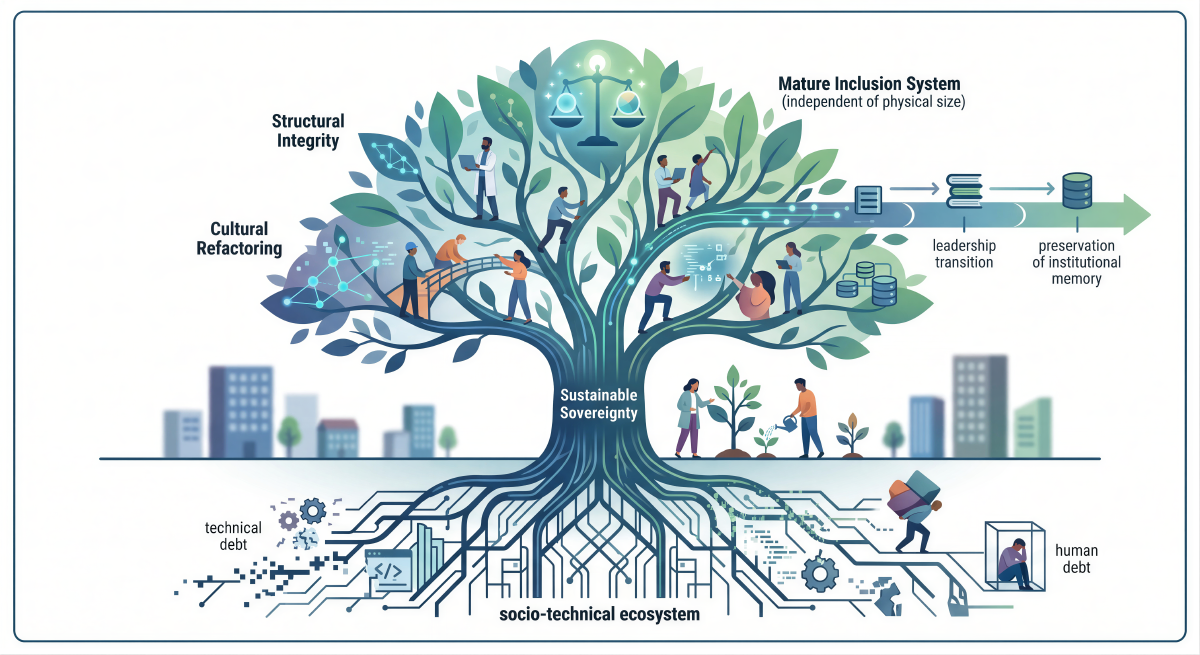
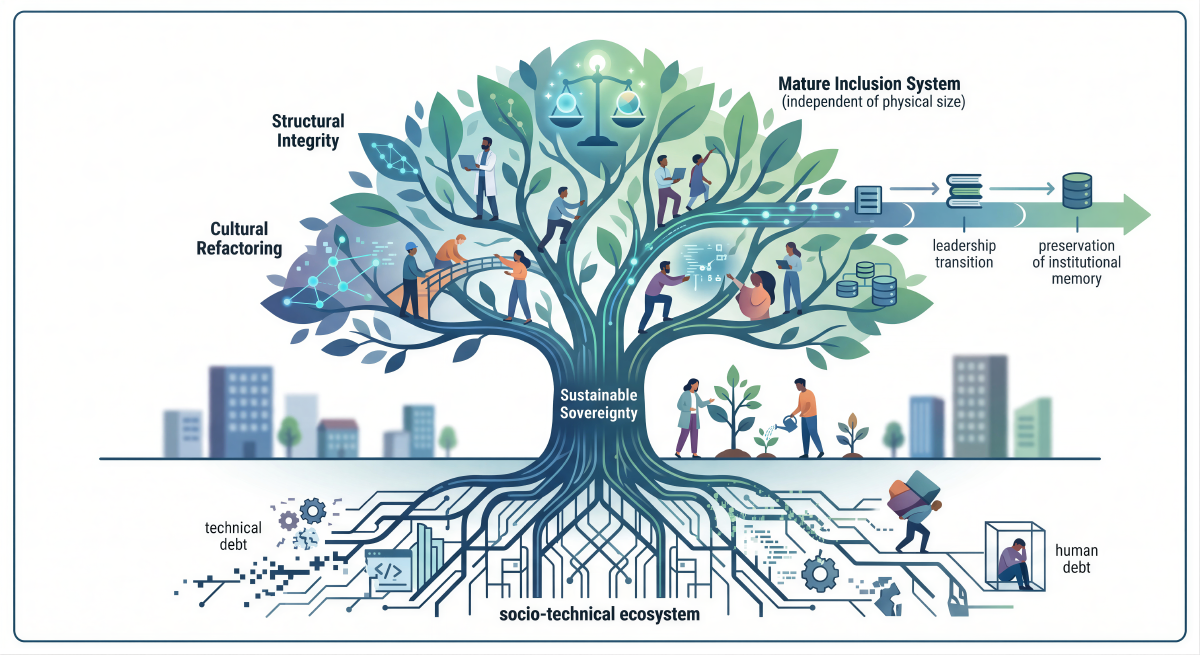
Institutional memory cannot be preserved if the human capital that carries it is systematically degraded. Just as technical debt undermines complex software architecture, “Human Debt” compromises the structural integrity of a socio-technical ecosystem. Human debt accumulates inexorably due to persistent gaps in psychological safety, insufficient inclusive support, and inequitable representation within the workplace.
Crucially, the burden of human debt is rarely distributed equally across an organization. It falls disproportionately on underrepresented engineers, researchers, and minority employees who must navigate compounded challenges within rigid hierarchical structures and traditional academic environments. To sustain cultural sovereignty, leaders must engage in deliberate “cultural refactoring”. This requires moving beyond performative diversity statements and implementing active maintenance through transparency, genuine allyship, and creating environmentally sustainable conditions for all professionals.
Measuring this progress requires assessing the organization’s maturity. Cluster analysis reveals two distinct organizational profiles on this metric: “Embedded Strategists,” who weave inclusion into the enterprise’s structural fabric, and “Symbolic Starters,” who treat inclusion as a peripheral public-relations exercise. Research demonstrates that mature inclusion systems positively predict external employee perceptions and operational durability, completely independent of the organization’s physical size. Longitudinal tracking of these systems during leadership transitions ensures that system-level change translates into actual lived experience, preventing the catastrophic loss of institutional memory that occurs when marginalized talent unexpectedly departs.
The Perils of Organizational Amnesia#
The failure to architect sustainable institutional memory has catastrophic consequences, particularly in high-stakes environments. In military and volunteer organizations, personnel turnover is rapid, and recruits are often entirely unaware of previous strategic efforts. Without a robust system to capture behavioral mechanics and operational lessons, large-scale systems suffer from profound organizational amnesia. Historically, this lack of institutional feedback and memory has resulted in absurd inefficiencies, such as the United States military essentially “fighting the first year of a war nine times in succession” because lessons learned were never structurally codified.
To combat this, leading institutions employ advanced knowledge elicitation techniques, such as concept map-based knowledge capture, to preserve unstructured qualitative data. By transitioning this raw data into interconnected socio-technical environments, organizations can transcend the limitations of the individual human mind, supporting interactions that build robust, shared artifacts of corporate memory.
Architecting “Social Software” as Cultural Connective Tissue#
The term “Social Software” emerged in the early 2000s to describe computing tools designed to support, extend, or add value to human social activity across networks. Its origins date to the advent of Web 2.0 and the “Enterprise 2.0” movement, spearheaded by academics like Andrew McAfee in 2006, which championed the introduction of wikis, internal corporate blogs, and messaging tools into the workplace. These applications were initially deployed to facilitate basic knowledge management, project coordination, and the circumvention of geographical boundaries.
However, as the digital workplace matured, the concept of social software evolved far beyond its technological origins. It now serves as a potent, expansive metaphor for the organizational culture itself, the “social glue” that dictates behavioral patterns, modifies traditional hierarchical management authority, and fosters a participatory ecosystem. Social software, in this metaphorical sense, is the architecture of human engagement.
The Evolution from Features to Behavioral Architecture#
Early implementations of social software in corporate environments were plagued by a distinct “hare versus tortoise” dynamic. Software vendors and reactive executives, acting as the “hare,” attempted to force organizational agility by merely dropping new collaboration tools onto a workforce, erroneously equating the deployment of shiny new features with the spontaneous generation of a collaborative culture. This approach invariably fails because it completely ignores the necessity of behavioral transformation.
Conversely, the “tortoise” approach eloquently integrates organizational culture, deep employee engagement, and behavioral psychology with the underlying technology. In a highly receptive organizational culture arrangement, Enterprise Social Software (ESS) represents a natural transition from the rigid Knowledge Management era. By designing socio-technical infrastructures that empower employees, organizations foster “cultures of participation”. In these environments, employees transition from being passive consumers of top-down corporate mandates to empowered co-creators of institutional knowledge. This transition is heavily reliant on “meta-design”, the creation of social and technological infrastructures wherein new forms of collaborative design can come alive organically.
The emergent nature of social software often yields unpredictable but highly beneficial cultural cascades. A historical example of this occurred within the Thought Farmer platform, where a single user whimsically changed his profile picture to a vintage image of actor Tom Selleck. Because the software’s activity stream broadcast this action across the network, it triggered a massive, spontaneous cascade of profile picture changes throughout the organization, forging an impromptu moment of massive cultural cohesion. Had the organizational culture been rigidly controlled, this emergent phenomenon would have been suppressed; instead, architecture allowed social software to reflect and amplify the actual human dynamics of the workforce.
The Spatial Metaphor: Virtual Environments and Innovation#
The architecture of social software often mimics physical space to drive behavioral outcomes. In its exploration of collaborative development, IBM constructed a virtual Metaverse environment for its global employees, reasoning that productive meetings do not fundamentally require physical walls and ceilings. IBM’s environment famously featured a gigantic virtual “green boulder” that served as the digital equivalent of a corporate water cooler. The underlying psychological hypothesis was that if employees from disparate global regions organically gathered around the boulder for informal chats, they would build the trust necessary to collaborate on highly complex future projects.
This emphasis on spatial connection became a critical survival mechanism during the unprecedented disruptions of the COVID-19 pandemic. Enterprise Social Media (ESM) platforms, such as Microsoft Yammer, Meta’s Workplace, Salesforce Chatter, and Oracle Social Network, became the sole connective tissue for isolated workforces. By participating in these virtual workspaces, individual employees were able to maintain their roles and a strong semblance of structural integrity within their business teams despite extreme geographic fragmentation. The study of these environments reveals that ESMs essentially served as vital catalysts for employee-driven participatory innovation during the work-from-home crisis, proving that social software can sustain institutional momentum even when the physical enterprise is paralyzed.
Echo Chambers and the Management of Trust#
While social software binds a culture, it also possesses the inherent risk of fracturing it if poorly architected. The “Echo Chamber” metaphor is highly relevant to how Enterprise Social Media structures employee attention and filters information. These platforms implicitly dictate the kinds of signals workers emit and how these signals foster trust among colleagues. If employees utilize the software solely to connect with like-minded individuals, the organization risks forming isolated ideological or functional silos that degrade overall structural Containment.
However, when properly managed, communication initiatives utilizing enterprise social networks successfully instill shared corporate values across all operational layers. When shop-floor employees interact seamlessly and transparently with top-tier management, institutional trust is heavily fortified. Personnel become deeply willing to share nuanced knowledge, flag potential systemic failures, and collaborate to resolve operational defects before they escalate into critical emergencies.
Reconciling Work as Imagined with Work as Done#
To ensure sustainable performance and the seamless transfer of institutional memory, organizations must bridge the gap between leadership’s vision and the workforce’s reality. True structural alignment requires a total rejection of “Work as Imagined”, the idealistic fallacy of how tasks should be performed, in favor of engineering for “Work as Done”, the unpolished, visceral reality of daily operations.
When leadership transitions occur, superficial or purely procedural changes inevitably collapse because they were never woven into the actual workflow. Lasting results require a foundational shift: synchronizing people, processes, and technology in an organic sequence. By using frameworks such as the Dual-ROI and Judgment Stack, organizations ensure that decisions are grounded in the realities of the organizational floor. Institutional memory is not built through sudden bursts of executive brilliance, but through the quiet, disciplined, and consistent refinement of minor structural elements over time.
The Architectural Approaches to Social Software#
The way an organization chooses to architect its “Social Software” determines whether it builds legacy or merely a temporary facade.
1. The Feature Drop (The Hare)
- Architectural Approach: This method prioritizes “shiny objects,” mass licensing, and rapid, thoughtless technological deployment. It assumes that the tool itself will create the culture.
- Cultural Consequence: Leads to low adoption rates. Technology remains a superficial layer that fails to penetrate or alter deeply rooted organizational behaviors.
2. The Control Harness
- Architectural Approach: This approach attempts to tightly manage, monitor, and restrict community interactions and content generation. It treats social software as a surveillance or compliance tool.
- Cultural Consequence: Stifles social creativity and fails to capture genuine institutional memory. It relies entirely on the flawed concept of “Work as Imagined,” leading to a disconnect with the workforce’s actual needs.
3. The Social Glue (The Tortoise)
- Architectural Approach: This method focuses relentlessly on behavioral change, cultural alignment, and cultivating organic connections over rigid control. It prioritizes the “human” element of the socio-technical system.
- Cultural Consequence: Establishes sustainable cultures of participation and reduces “human debt.” It fosters profound structural integrity, enabling the system to survive leadership transitions and external shocks.
Engineering Structural Integrity Across Leadership Transitions#
Organizations face their absolute most severe existential threats during periods of transition. Whether navigating a generational succession in a legacy family business, executing a complex international merger, or scaling an early-stage startup into a global enterprise, the transition phase mercilessly exposes every hidden flaw in the organizational architecture. Furthermore, many nonprofit and mission-driven enterprises were built on historical assumptions of political, financial, and regulatory stability that they no longer hold. This leaves them acutely vulnerable to catastrophic disruption when funding contracts, public policies shift, or founding leaders inevitably transition out of power.
The Shift from Heroics to Institutional Capability#
To survive these transitions, an organization must deliberately engineer institutional durability long before a crisis manifests. This requires moving definitively away from the romanticized paradigm of “individual heroics” or personality-dependent leadership, shifting instead toward systems-based performance architecture.
According to advanced frameworks developed by transition advisory entities such as JF Bicking & Co., building sustainable leadership architecture mandates three distinct developmental stages to secure enterprise structural integrity:
- Assessment: Diagnosing existing authority ambiguity, identifying succession exposure, measuring cultural strain, and mapping points of friction within board governance and executive alignment.
- Design: Defining highly scalable workflows, mapping explicit accountability logic, establishing oversight cadences, and integrating systems pathways. This requires establishing formal boundaries regarding decision rights across all leadership tiers, effectively moving away from implicit assumptions to explicit architectural rules.
- Reinforcement & Enablement: Supporting the complex implementation sequencing, embedding governance cadences into daily operations, and guiding continuous leadership alignment to guarantee long-term durability.
When leadership strain inevitably emerges during scaling or restructuring, informal systems that previously functioned perfectly begin to fracture under the new weight. Authority boundaries blur, decision rights overlap dangerously, executive alignment weakens, and succession remains implicit, resulting in massive performance volatility. Sustainable enterprises do not leave authority, succession, and governance coherence to chance; they institutionalize explicit, unshakeable pathways.
The Complex Dynamics of Family Business Succession#
The absolute necessity of engineered structural integrity is vividly illustrated within family-owned enterprises facing generational transitions. It is a well-documented psychological phenomenon that families generally operate in their business environments with the same behavioral dynamics they exhibit at home. Families capable of maintaining open, albeit highly uncomfortable, dialogues in their private lives are naturally equipped to navigate the profound discomfort of corporate succession planning.
For a family business to achieve sustainable sovereignty across multiple generations, it requires a clear hierarchy, firmly defined boundaries, and explicitly stated rules regarding critical issues such as work ethic, compensation logic, and the honoring of legacy traditions. In family dynamics, personnel often adopt highly specific roles over time, such as the mediator, the planner, the compliant executor, or the rebel. When members of a family enterprise understand how their distinct psychological roles map onto the business architecture, the organization possesses the structural integrity required to ensure that transitions are predictable and exceptionally smooth. Conversely, when a family relies entirely on covert behavioral assumptions and lacks functional, overt structure, non-normative transitions plunge the entire enterprise into chaos and highly destructive litigation.
Manifesting Enduring Impact Through Deliberate Design#
As articulated by experts such as Alan S. Gutterman, achieving meaningful, long-term impact requires a fundamental philosophical shift across the entire organizational sector. Organizations must shift their primary emphasis from the relentless pursuit of exponential growth to a sober focus on durability; from unquestioning market optimism to rigorous structural preparation; from rapid expansion to deep structural integrity; and from chasing short-term wins to securing generational continuity.
Treating endurance as the primary design objective from a company’s inception ensures that governance structures, financial reserve systems, and executive succession protocols are deliberately engineered to withstand extreme market volatility while preserving strict fidelity to the organization’s founding mission. The fully systemized enterprise behaves predictably because its culture is stable without becoming rigid, and its governance is respected because it is inherently tied to the organization’s structural reality.
Physical Metaphors: Architecture and Adaptive Reuse#
The abstract principles of sustainable sovereignty, social software, and institutional memory are beautifully mirrored in the physical world through the architectural practice of “adaptive reuse.” Just as the social software of an organization must be deliberately architected to evolve and accept new generational loads, the physical structures that house our societies can be intelligently repurposed to preserve deep historical heritage while simultaneously meeting the rigorous demands of the future.
Repurposing the Obsolete for Future Generations#
Adaptive reuse is a highly forward-thinking approach to urban development that revitalizes existing buildings, offering a highly sustainable alternative to the ecologically destructive cycle of continuous demolition and new construction. As global cities increasingly grapple with rapid urbanization, catastrophic climate change, and acute resource scarcity, adaptive reuse emerges as an architectural methodology that protects historical legacy, stimulates economic growth, and drastically reduces environmental impact.
Consider the profound transformation of outdated industrial infrastructures. Architectural firms have successfully converted 19th-century manufacturing plants into 21st-century makerspaces (such as Worrell Yeung’s projects in Brooklyn), retrofitted historic printing facilities into cutting-edge biotech laboratories (executed by HOK in St. Louis), and transformed abandoned cheese factories into contemporary art spaces (designed by Wheeler Kearns in Chicago). In each of these instances, the structural integrity of the original building, its deep foundation, its load-bearing masonry, and its spatial geometry is strictly maintained. The “software” of the building, its daily programmatic usage, its technological outfitting, and the flow of human traffic, is completely updated. This adaptive reconfiguration allows the founders’ initial architectural vision to support entirely new generations of inhabitants doing entirely new forms of work.
Ancient Geometry and the Preservation of Cultural Identity#
The drive to manipulate surroundings to achieve lasting, sovereign impact dates to the dawn of prehistoric architecture. Ancient civilizations constructed megaliths and stone circles, such as Stonehenge, utilizing highly specific geometric forms. These early architects drew inspiration from the most influential forms in their environment, predominantly circles mimicking the sun and the moon, to encode deep societal meaning into stone. Despite the complete absence of written records or formal data storage, the architectural layout of these monuments successfully transmitted prehistoric understandings of celestial mechanics and cultural priorities over thousands of years.
Similarly, modern structures are specifically designed to preserve and celebrate indigenous memory, proving that architecture is a form of social software. The Brambuk Living Cultural Center in Australia, situated within the Grampians National Park, operates as a public cultural space explicitly architected to commemorate the heritage of local communities. The success of such a structure relies heavily on the integration of deep sociological methods during the predesign and programming phases. By conducting exhaustive surveys of presumed building users and conducting neighborhood needs assessments, architects ensure that the physical space aligns flawlessly with the behavioral mechanics and cultural identity it intends to preserve.
This physical adaptive reuse perfectly encapsulates organizational sustainable sovereignty: it recognizes that the foundational structures built by our predecessors possess intrinsic, unquantifiable value, and that long-term survival is achieved not by discarding the past, but by intelligently reconfiguring its capacity to endure new environmental loads.
Macro-Level Sustainable Sovereignty: Indigenous, National, and Geopolitical Contexts#
While sustainable sovereignty is critically important at the micro-level of corporate culture and organizational design, it is simultaneously becoming the defining paradigm at the macro-level of statecraft, environmental stewardship, and geopolitical infrastructure. The mechanics of cultural legacy remain the same whether applied to a tech startup or a sovereign nation.
Indigenous Sustainability and Cultural Preservation#
In the highly complex realm of tribal governance, sustainable sovereignty signifies a nation’s absolute capacity to govern its resources independently, charting a distinct course toward environmental stewardship and societal well-being without undue external interference. For indigenous nations, sovereignty is inextricably linked to cultural preservation and the active avoidance of systemic cultural extinction.
The debates surrounding tribal citizenship requirements powerfully illustrate the tension between maintaining boundaries and preserving culture. The historical reliance on “blood quantum” requirements, originally a construct of colonial policy, has been criticized for mathematically guaranteeing the eventual defining out of tribal existence. Conversely, shifting toward sustainable, sovereignty-centered citizenship requirements based on lineal descent requires an infrastructure capable of identifying individuals who will actively engage as good citizens and uphold the cultural legacy.
Educational programs focusing on Indigenous leadership are currently formalizing this cultural architecture. For example, Western Michigan University’s MPA program partnered with three Potawatomi tribes to launch a course titled “Tribal Governance: Sovereignty through Self-Determination”. This program introduces the theoretical and practical applications of governance from an indigenous perspective, focusing on the path to federal recognition, nation rebuilding, and sustainable sovereignty. By formally studying the social, economic, and political resilience demonstrated by tribes since the Indian Self-Determination Act of 1975, the program essentially serves as a robust institutional memory bank.
Furthermore, indigenous stewardship of the environment deeply integrates traditional ecological knowledge with modern administrative science. The management of manoomin (wild rice), the stewardship of nibi (water), and the controlled application of ishkode (fire) are not merely agricultural practices; they are deeply sovereign, culture-affirming practices that guide sustainable decision-making for future generations.
Geopolitical Identity and Resource Independence#
On the global stage, sustainable sovereignty requires nations to secure their physical and political independence through strategic architecture. The Republic of Armenia, for example, seeks to ensure the solid foundations of its national security by consolidating a democratic political identity that transcends the mere confines of ethnicity, language, or religion. Determining an internal political identity built on individual freedoms is the key to unlocking national talent, consolidating a patriotism that drives sustainable sovereignty amid complex extra-regional entanglements.
Similarly, Hungary approaches sustainable sovereignty through the lens of energy independence and resource geopolitics. Recognizing that the future of sovereignty will be determined not solely by physical borders but by control over power grids, pipelines, and critical mineral supply chains, Hungary has forged partnerships with Turkic states like Azerbaijan while simultaneously expanding nuclear, geothermal, and solar energy capacities. In regions like Alaska’s Arctic, sustainable sovereignty is defined by the critical intersection of localized food production and national security, ensuring that remote populations can survive supply chain disruptions.
The failure to establish this independence leads to catastrophic vulnerability. In scenarios of nation-building under occupation, the occupied nation often develops a severe economic and administrative reliance on the occupying power. This dependency completely hinders long-term self-governance, immensely complicating the transition to true sustainable sovereignty once the occupier eventually withdraws.
Engineering Digital Sovereignty in the Age of AI and Cloud Infrastructure#
In the contemporary global economy, maintaining organizational and cultural sovereignty requires navigating severe technological dependencies. The physical borders of a nation and the operational walls of a corporation are routinely bypassed by the digital infrastructure that powers them.
The Three Pillars of Cloud Sovereignty#
To avoid structural collapse caused by sudden external technological failures or geopolitical sanctions, enterprises and states alike must secure digital sovereignty. Technology firms like Schuberg Philis advocate that organizations achieve this by conducting scenario-based analyses to define their “crown jewels”, the mission-critical business processes that must survive any disruption.
Comprehensive digital sovereignty rests on three highly specific pillars, as outlined by enterprise cloud providers like T-Systems:
- Data Sovereignty: Maintaining absolute, uncompromising control over data location, access protocols, physical security, and privacy, ensuring total compliance with localized regulatory requirements (such as GDPR).
- Software Sovereignty: Retaining the operational freedom to heavily customize utilized software and develop proprietary applications that fulfill specific business or cultural needs, preventing vendor lock-in.
- Operational Sovereignty: The capacity to self-manage and directly dictate the functions of cloud infrastructures, ensuring that business-critical processes remain under direct internal control even if international partnerships dissolve.
When these three pillars are successfully synthesized, an organization or nation achieves the ultimate objective: Sustainable Sovereignty in the digital realm.
Reclaiming Public Infrastructure in the Global South#
The Global South faces the critical historical challenge of ensuring that massive modern investments in digital infrastructure lead to genuine sovereignty rather than a new insidious paradigm of colonial dependency on external Western technology providers. Reclaiming sovereignty involves designing and locally controlling critical digital public infrastructure (DPI).
By developing localized digital payment systems and sharing data governance frameworks through regional bodies like MERCOSUR and CELAC, these nations reduce their reliance on international card networks and expand financial inclusion. However, the success of these initiatives ultimately depends on the careful cultivation of indigenous technological talent and the establishment of robust, independent regulatory institutions capable of maintaining the digital architecture over time.
Middle Powers and the Artificial Intelligence Arms Race#
The rapid advancement of Artificial Intelligence presents the ultimate test of sustainable sovereignty. Middle powers currently cannot match the massive scale at which global superpowers such as the United States and China collect data to train AI systems. Consequently, to weather this AI dominance, middle powers must rely heavily on their human capital and the structural integrity of their research ecosystems.
For AI capabilities to translate into a true national advantage, they must be widely and effectively adopted. Therefore, legitimacy, digital literacy, and user trust are central to sustainable AI sovereignty. Trust is managed across diverse governance contexts through mechanisms such as Digital Identity Pattern Extraction (DIPE), which integrates social software data, mitigates information overload, and aligns workflows with overarching organizational and national policies.
Simultaneously, AI is being deployed to train the next generation of architects and engineers. In educational environments, AI-powered virtual simulations allow students to test the structural integrity of a physical bridge or operate robotic arms without physical danger. These systems provide rich data for formative assessments, effectively scaling the transfer of complex institutional memory to thousands of learners simultaneously. Just as dense multi-modal registration and image-guided cost aggregation assess structural anomalies in digital engineering, advanced social software and diagnostic frameworks map the hidden structural boundaries of our human organizations.
Synthesis of Institutional Durability#
Designing a culture that outlasts its original architects requires a total, uncompromising rejection of the premise that organizational survival depends on the continuous presence of visionary individuals. The cult of the indispensable leader is a symptom of structural fragility. Instead, institutional immortality must be deliberately engineered through the disciplined application of Sustainable Sovereignty. By prioritizing ultimate control through deep adaptability, organizations can navigate volatile generational and technological transitions, ensuring that their foundational structural integrity, the critical, multiplicative balance between operational Capacity and cultural Integrity, remains unbroken.
The behavioral mechanics of institutional memory are forged early in the gravitational field of founders, but they must be continuously codified and expanded through the careful implementation of Social Software. When utilized not merely as a suite of digital tools, but as the fundamental “social glue” and behavioral architecture of an enterprise, this infrastructure mitigates human debt, dismantles rigid operational silos, and establishes a highly resilient culture of participatory co-creation. Furthermore, by formalizing leadership architecture, transforming implicit authority and assumed succession into explicit, systemic governance, an organization effectively immunizes itself against the inevitable shock of sudden executive departures.
Ultimately, whether observing the adaptive reuse of prehistoric physical architecture, the fierce preservation of indigenous cultural heritage, or the strategic, geopolitical fortification of sovereign digital cloud infrastructure, the primary lesson remains strictly uniform: enduring impact is never the result of sudden brilliance or luck. It is the result of meticulous structural design. Organizations that master the mechanics of sustainable sovereignty guarantee that their foundational purpose, embedded deeply within their social architecture, will continue to execute flawlessly long after the original architects have departed the stage.
References#
- Lomet, F. (2025). From Cognitive Extraction to Preservation: The Infrastructure of Sustainable Value. HAL Open Science, hal-05358895.
- Taber, Jay. (2025). Institutional Memory as Community Safeguard. Fourth World Journal. 7. 62-74. 10.63428/wctyk008.
- Reinders Folmer, C. P., Kuiper, M. E., & van Rooij, B. (2026). The People versus Behavioral Science: Alignment between lay and scientific understanding of compliance. PloS one, 21(1), e0338675.
- Burton, Richard & Håkonsson, Dorthe & Eriksen, Bo & Snow, Charles. (2006). Organization Design: The evolving state-of-the-art. 10.1007/0-387-34173-0.
- Ambo, T. J., & Stewart, K. L. (2025). Remembering, Restorying, and Reclaiming in the Wake of Erasure. University of Victoria Space Repository.
- Vamanu, Iulian. (2026). RESISTING ERASURE: INDIGENOUS CURATORSHIP AND THE DYNAMICS OF REMEMBERING AND FORGETTING. The Annals of the University of Bucharest, Philosophy Series. 74. 161-181. 10.62229/aubpslxxiv/1_25/9.
- Jian, Guowei. (2007). Unpacking Unintended Consequences in Planned Organizational Change: A Process Model. Management Communication Quarterly - MANAG COMMUN Q. 21. 5-28. 10.1177/0893318907301986.
- Howard, Grant. (2020). A Change and Constancy Management Approach for Managing the Unintended Negative Consequences of Organizational and IT Change. Lecture Notes in Business Information Processing. 402. 683-697. 10.1007/978-3-030-63396-7_46.
- Sydow, Georg & Schreyögg, Georg & Koch, Jochen. (2008). Organizational Path Dependence: Opening the Black Box. Helfat Huff & Huff. Gilbert. 10.5465/AMR.2009.44885978.
- Georg Schreyögg & Jörg Sydow, 2010. “Understanding Institutional and Organizational Path Dependencies,” Palgrave Macmillan Books, in: Georg Schreyögg & Jörg Sydow (ed.), The Hidden Dynamics of Path Dependence, chapter 1, pages 3-12, Palgrave Macmillan.
- Leonardi, Paul & Vaast, Emmanuelle. (2017). Social Media and Their Affordances for Organizing: A Review and Agenda for Research. Academy of Management Annals. 11. 150-188. 10.5465/annals.2015.0144.
- Kane, Gerald. (2017). The evolutionary implications of social media for organizational knowledge management. Information and Organization. 27. 10.1016/j.infoandorg.2017.01.001.
- Treem, Jeffrey & Leonardi, Paul. (2012). Social Media Use in Organizations: Exploring the Affordances of Visibility, Editability, Persistence, and Association. SSRN Journal. 36. 10.2139/ssrn.2129853.
- Majchrzak, Ann & Kane, Gerald & Azad, Bijan & Faraj, Samer. (2013). The Contradictory Influence of Social Media Affordances on Online Communal Knowledge Sharing. Journal of Computer-Mediated Communication. 19. 38-55. 10.1111/jcc4.12030.
- Ellison, Nicole & Gibbs, Jennifer & Weber, Matthew. (2015). The Use of Enterprise Social Network Sites for Knowledge Sharing in Distributed Organizations. American Behavioral Scientist. 59. 103-123. 10.1177/0002764214540510.
- Leonardi, Paul. (2018). Social Media and the Development of Shared Cognition: The Roles of Network Expansion, Content Integration, and Triggered Recalling. Organization Science. 29. 10.1287/orsc.2017.1200.
- Falkner, Gerda & Heidebrecht, Sebastian & Obendiek, Anke & Seidl, Timo. (2024). Digital sovereignty - Rhetoric and reality. Journal of European Public Policy. 31. 1-22. 10.1080/13501763.2024.2358984.
- Sheikh, Haroon. (2022). European Digital Sovereignty: A Layered Approach. Digital Society. 1. 10.1007/s44206-022-00025-z.
- Bower, Courtney. (2024). Ukraine’s Wartime Digitalization Efforts: 2022 to 2024. 10.13140/RG.2.2.29088.85763.
- Couture, Stéphane and Toupin, Sophie, What Does the Concept of ‘Sovereignty’ Mean in Digital, Network and Technological Sovereignty? (January 22, 2018). GigaNet: Global Internet Governance Academic Network, Annual Symposium 2017, Available at SSRN: https://ssrn.com/abstract=3107272 or http://dx.doi.org/10.2139/ssrn.3107272
- Mueller, Milton. (2019). Against Sovereignty in Cyberspace. International Studies Review. 22. 10.1093/isr/viz044.
- Lokmic-Tomkins, Z., Bhandari, D., Bain, C., Borda, A., Kariotis, T. C., & Reser, D. (2023). Lessons Learned from Natural Disasters around Digital Health Technologies and Delivering Quality Healthcare. International journal of environmental research and public health, 20(5), 4542. https://doi.org/10.3390/ijerph20054542
- Roberts, Huw & Hine, Emmie & Floridi, Luciano. (2023). Digital Sovereignty, Digital Expansionism, and the Prospects for Global AI Governance. 10.1007/978-3-031-41566-1_4.
- Roberts, H. & Cowls, J. & Casolari, F. & Morley, J. & Taddeo, M. & Floridi, L. (2021). Safeguarding European values with digital sovereignty: an analysis of statements and policies. Internet Policy Review, 10(3). https://doi.org/10.14763/2021.3.157
- Kumar, Ritesh. (2021). Multi-Cloud and Hybrid Cloud Strategies - Balancing Flexibility, Cost, and Security. International Journal For Multidisciplinary Research. 3. 10.36948/ijfmr.2021.v03i02.39459.
- Fonneland, T., & Ragazzi, R. (Eds.). (2024). Memory Institutions and Sámi Heritage: Decolonization, Restitution, and Rematriation in Sápmi (1st ed.). Routledge. https://doi.org/10.4324/9781003426318
- Morrissey, Robert. (2025). Traditional Ecological Knowledge and Sustainability. 10.1093/obo/9780197768709-0020.
- Nepal, Tej. (2024). The Role of Traditional Ecological Knowledge in Environmental Stewardship: Beyond Poverty and Necessity. 10.20944/preprints202406.1838.v1.
- Whyte, K. P. (2018). Indigenous science (fiction) for the Anthropocene: Ancestral dystopias and fantasies of climate change crises. Environment and Planning E: Nature and Space, 1(1-2), 224-242.
- Carroll, Stephanie & Rigney, Daryle & Hemming, Steve & Della-Sale, Amy & Booker, Lauren & Berg, Shaun & Behrendt, Larissa & Bignall, Simone. (2023). Indigenous Data Sovereignty, Repatriation and the Biopolitics of DNA. 10.4324/9781003144953-11.
- Gutterman, A. S. (2026). The Sustainable Entrepreneur. Available at SSRN.
- Gutterman, A. S. (2024). Sustainable finance and impact investment: a guide for sustainable entrepreneurs. Available at SSRN 4944162.
- Gutterman, A. S. (2024). Sustainability Standards and Instruments: A Guide for Sustainable Entrepreneurs. Available at SSRN 3804430
- Uhl-Bien, Mary & Arena, Michael. (2018). Leadership for organizational adaptability: A theoretical synthesis and integrative framework. The Leadership Quarterly. 29. 10.1016/j.leaqua.2017.12.009.
- Boin, R. A., & van Eeten, M. (2013). The resilient organization: A critical appraisal. Public Management Review, 15(3), 429-445.
- Conejos, S., Langston, C., & Smith, J. (2015). Enhancing sustainability through designing for adaptive reuse from the outset. Facilities, 33(9/10), 531-552. https://doi.org/10.1108/f-02-2013-0011
- Conejos, Sheila & Langston, Craig & Smith, Jim. (2015). Enhancing sustainability through designing for adaptive reuse from the outset: A comparison of adaptSTAR and Adaptive Reuse Potential (ARP) models. Facilities. 33. 531-552. 10.1108/F-02-2013-0011.
- Plevoets, B., & Van Cleempoel, K. (2019). Adaptive Reuse of the Built Heritage: Concepts and Cases of an Emerging Discipline (1st ed.). Routledge. https://doi.org/10.4324/9781315161440
- Peoples, Sharon. (2014). Intangible heritage and the museum: new perspective on cultural preservation. International Journal of Heritage Studies. 20. 10.1080/13527258.2014.913343.