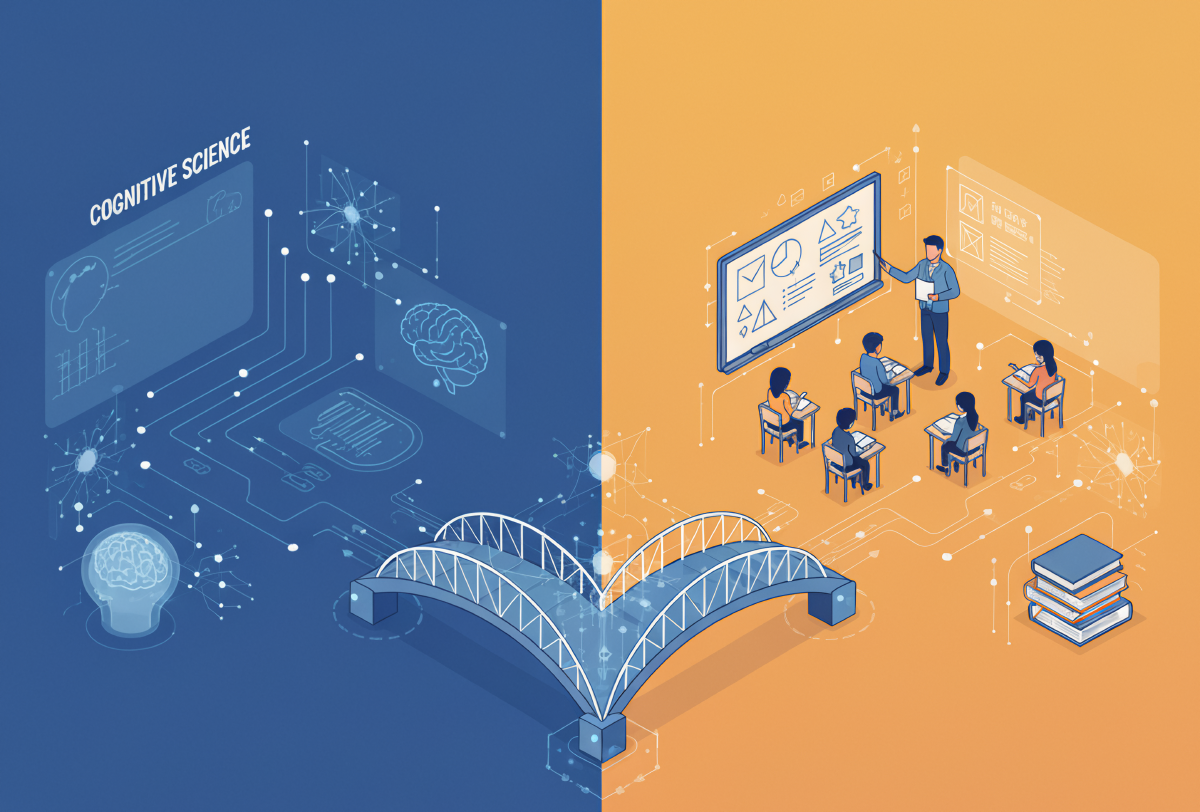
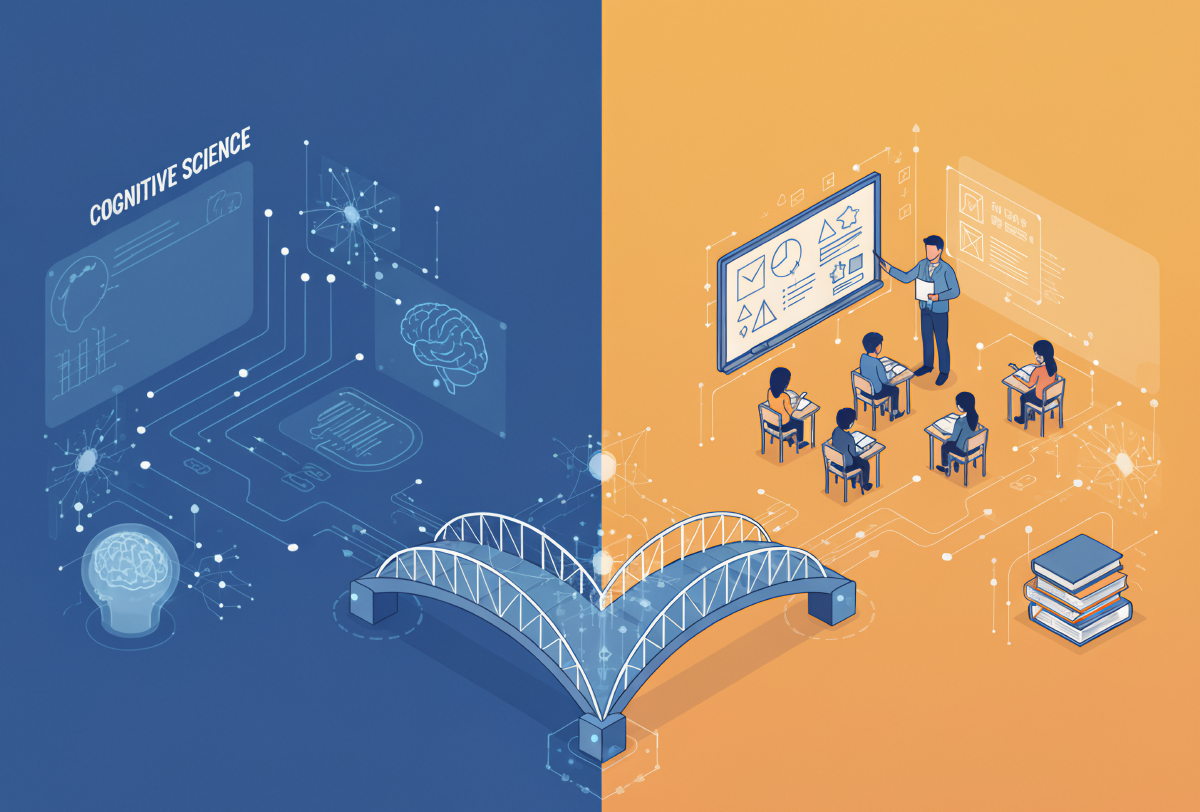

Introduction: Bridging Cognitive Science and Educational Practice#
Educational methodologies have historically been shaped by tradition, pragmatism, and philosophical inquiry, often with limited integration of empirical evidence from the learning sciences. This disjuncture has persisted despite decades of rigorous research in cognitive psychology and neuroscience that elucidate the fundamental architecture and processes of human learning. A critical synthesis of this research is essential to inform and evolve pedagogical practice, moving it from a reliance on intuition to a foundation in evidence-based principles.
This article presents a comprehensive framework for such a synthesis, articulating the core tenets of cognitive science and their direct implications for instructional design. We begin by examining the foundational architecture of the human cognitive system, with a specific focus on the critical interplay between the severely capacity-limited working memory and the vast, schema-structured repository of long-term memory. This model positions learning as an active process of encoding, consolidating, and retrieving information, constrained by the bottleneck of attentional resources and vulnerable to cognitive overload.
Building upon this foundation, the article delves into two pivotal theoretical frameworks that provide actionable guidance for instructional design. Cognitive Load Theory (CLT) offers a diagnostic model for analyzing and managing the intrinsic, extraneous, and germane loads imposed on learners’ working memory. Complementarily, Dual Coding Theory elucidates the cognitive mechanisms by which the simultaneous presentation of verbal and non-verbal information can optimize processing and enhance retention by leveraging distinct cognitive channels.
Further, we review a suite of empirically validated learning strategies, retrieval practice, spaced repetition, and interleaving, that function as “desirable difficulties” to promote robust, long-term knowledge formation and enhance transfer. The discussion extends to higher-order cognitive processes, including the cultivation of metacognitive skills and the developmental trajectory from novice to expert, characterized by qualitative shifts in knowledge organization and application.
Finally, we contextualize these cognitive principles within broader pedagogical approaches, such as inquiry-based learning, and address the practical challenges of implementation, including the role of educational technology and the translation of laboratory findings into diverse classroom environments. The overarching aim of this synthesis is to provide a coherent, evidence-based conceptual framework that empowers educators and designers to create learning experiences that are systematically aligned with the science of how the mind learns.
The Cognitive Foundations of Learning#
Defining Cognitive Science: An Interdisciplinary Approach to the Mind#
Cognitive science is the interdisciplinary, scientific study of the mind and its processes. It is a field dedicated to unraveling the intricate mechanisms of thought, examining the nature, the tasks, and the functions of cognition in its broadest sense. At its core, cognitive science seeks to understand how the mind represents and manipulates knowledge, and how these mental representations and processes are physically realized in the brain. The field operates on the foundational premise that thinking can be understood as the operation of computational procedures on representational structures within the mind. This perspective allows for a systematic investigation into the mental faculties that are foundational to all educational endeavors: perception, memory, attention, reasoning, language, problem-solving, and emotion.
The true power of cognitive science lies in its synthesis of methodologies and perspectives from a wide and diverse range of disciplines. It is not a monolithic field but a vibrant intellectual intersection that includes:
- Psychology: Provides the empirical methods for studying human behavior and mental processes, offering insights into learning, memory, and development.
- Neuroscience: Investigates the brain’s activity and functionality at the neural level, exploring how mental processes are implemented in the brain’s physical structures and circuits.
- Linguistics: Studies the structure of language and how it is acquired and used, providing a critical window into a uniquely human and highly complex cognitive faculty.
- Computer Science and Artificial Intelligence (AI): Contributes tools of computational modeling and the theoretical framework of information processing. AI seeks to implement aspects of human intelligence in machines, which in turn serves as a powerful method for testing and refining theories about human cognition.
- Philosophy: Addresses fundamental questions about the nature of knowledge, reality, and consciousness, providing the conceptual groundwork for the entire field.
- Anthropology: Explores how cognition is shaped by and embedded within different cultural contexts, ensuring that theories of the mind account for human diversity.
This multi-level approach is a core tenet of the field. Cognitive scientists argue that a complete understanding of the mind and its processes cannot be achieved by studying only a single level of organization, from the firing of individual neurons in neural circuitry to the complex, culturally-situated decision-making of an individual. The direct and profound relevance of this work to education lies in its potential to illuminate the fundamental workings of learning. By understanding the mechanisms of how students perceive stimuli, process information, retain knowledge, and develop skills, educators can move beyond tradition and intuition. They can begin to design teaching strategies, curricula, and entire educational programs that are systematically aligned with the architecture of the human mind, thereby optimizing instruction to meet the diverse needs of all students.
The Human Memory System: The Critical Interplay of Working and Long-Term Memory#
A prevalent and highly useful model in cognitive science describes human cognitive architecture as comprising two primary, interacting memory systems: working memory and long-term memory. From this perspective, learning is fundamentally defined as the process of selecting, organizing, and integrating new information, ultimately transferring it from the severely limited working memory into the vast repository of long-term memory. This transfer is not a passive event but an active, multi-stage process. It involves three distinct stages: encoding (the initial processing and interpretation of information), storage (the consolidation and integration of information in long-term memory), and retrieval (the subsequent accessing of that stored information for use). The effectiveness of each stage is critical for durable learning to occur.
Working Memory (WM) can be conceptualized as the active, conscious part of the mind where new information is processed and manipulated. It is the critical bottleneck through which all novel information and conscious thought must pass. This system is characterized by severe limitations in both capacity and duration. Research consistently indicates that working memory can typically only process a minimal number of novel information elements, or “chunks,” at any given time, with most estimates ranging from three to seven pieces of information. Furthermore, this information is held for only a very short period, often just a matter of seconds, unless it is actively rehearsed or processed. When this limited capacity is exceeded, a state known as cognitive overload occurs, significantly hampering or even ceasing the learning process. This makes the management of working memory load the central challenge of all instructional design.
A more detailed model of working memory, proposed by Alan Baddeley, further refines this concept, suggesting it is not a single entity but a multi-component system. This model includes a phonological loop for processing auditory and verbal information, a visuospatial sketchpad for processing visual and spatial information, and a central executive that acts as a control system, directing attention and coordinating the activities of the other components. This multi-component view is crucial as it forms the cognitive basis for theories like Dual Coding, which leverage these separate processing channels to make learning more efficient.
Long-Term Memory (LTM), in contrast, is a vast and effectively limitless storage system for all the knowledge and skills an individual possesses. Information is not stored as isolated, disconnected facts but is organized into intricate, interconnected networks of knowledge known as “schemas”. A schema is a mental framework that organizes information based on how it is used. Schemas can range in complexity from a simple concept (e.g., the definition of a word, the visual representation of a dog) to a highly complex and automated procedure (e.g., how to solve a multi-step physics problem, how to drive a car). As expertise develops, these schemas become not only more numerous but also more richly interconnected and hierarchically organized. A key process in this development is knowledge encapsulation, where detailed theoretical concepts, through repeated application and experience, are summarized into more general, high-level concepts that can be accessed more efficiently.
The concept of the schema is the key that unlocks high-level cognition and expertise. While working memory is severely limited in the number of new elements it can handle, it faces no such limits when processing information that has been retrieved from long-term memory. A highly complex schema, once activated and brought into working memory, is treated as a single, unified element. This mechanism is what allows experts to process vast amounts of domain-specific information effortlessly, as they can draw upon well-automated schemas that effectively bypass the constraints of working memory. This creates a powerful positive feedback loop for learning: the more organized knowledge one possesses in long-term memory, the more efficiently and effectively one can learn new, related information because there is an existing structure to which the new information can connect. This principle explains the profound cognitive differences between novices and experts and underscores why activating prior knowledge is not merely a preparatory activity but a cognitive necessity for meaningful learning. The primary goal of instruction, therefore, is the deliberate and structured construction of robust, accurate, and automated schemas in students’ long-term memory.
The Gateway to Learning: The Role of Attention and Its Three Networks#
Attention is the cognitive process of selectively concentrating on specific information from the environment while filtering out other irrelevant stimuli. It serves as the essential gateway through which information must pass to enter working memory for conscious processing. For learning to occur, students must actively direct their attention to new information; without attention, information is not processed, cannot be encoded, and therefore cannot be learned. Motivation and attention are deeply intertwined; what we are motivated toward is what we attend to, and what we attend to is what we learn.
Like working memory, attention is a finite resource. The human brain has a limited capacity to process the overwhelming complexity of the surrounding environment. Consequently, attempting to divide attention between multiple novel tasks simultaneously, a practice commonly known as multitasking, significantly impairs learning and performance. When attention is split, the cognitive resources available for each task are diminished, leading to shallower processing, a higher likelihood of errors, and poorer long-term retention. This is a critical challenge in modern classrooms, where digital and social distractions constantly compete for students’ limited attentional resources.
Modern neuroscience has revealed that attention is not a single, monolithic process. A prominent and influential model identifies at least three distinct, yet interacting, attentional networks within the brain, each with its own neural circuits and functions:
- Alerting Network: This network is responsible for achieving and maintaining a state of general alertness, vigilance, and preparedness to respond to incoming stimuli. It is the foundational state of readiness for learning. In a classroom, this is the network that allows students to settle after a break and become receptive to the teacher’s instruction.
- Orienting Network: This network governs the ability to select specific information from a wealth of sensory input. It directs the focus of attention to a particular stimulus or task, such as a teacher’s explanation, a specific passage in a textbook, or a relevant detail in a diagram. A failure in this network means a student might be alert but focusing on a butterfly outside the window instead of the geometry lesson.
- Executive Attention Network: This network involves the highest level of attentional control and is considered the most critical for the complex, goal-directed learning that occurs in academic settings. It is responsible for regulating complex cognitive processes, including planning, decision-making, and error detection. Crucially, it manages conflict between competing stimuli (e.g., ignoring a phone notification while solving a math problem) and controls thoughts and emotions to stay on task. This network is synonymous with selective attention, the ability to concentrate on a particular input while actively suppressing distractions.
These attentional networks undergo a prolonged period of development throughout childhood and adolescence, with the executive attention network showing the most extended maturation trajectory. This developmental process is influenced by both genetic and environmental factors, but importantly, the efficiency of these networks can be improved through targeted practice and training. This malleability highlights the critical importance of creating structured, predictable, and distraction-free learning environments. It also underscores the need to explicitly teach students how to manage their own attention, providing them with the metacognitive skills to recognize distractions and regulate their own focus.
Cognitive Load: The Central Bottleneck in Information Processing#
The concepts of limited working memory and selective attention converge in the overarching framework of cognitive load. Cognitive load refers to the total amount of mental effort, or information processing, imposed on the working memory system at any given time while performing a task. It is the central constraint that all instructional design must contend with. The fundamental goal of evidence-informed instruction is to manage this load effectively to facilitate the construction of schemas and the successful transfer of knowledge from working memory to long-term memory.
This does not mean simply minimizing all effort. Learning requires a certain amount of productive mental work. The goal is not to eliminate difficulty but to carefully orchestrate the demands placed on the learner. This involves avoiding debilitating overload caused by poorly designed instruction, while ensuring there is sufficient challenge to promote the deep and durable learning that leads to expertise. The principles of attention, working memory, and cognitive load are not disparate concepts but are deeply intertwined facets of a single, fundamental constraint on human learning. Attention is the mechanism that selects what enters working memory, and cognitive load is the measure of the strain placed upon that working memory. All effective instructional strategies are, at their core, sophisticated methods for managing this critical bottleneck to maximize the potential for meaningful and lasting learning.
Core Theories for Effective Instructional Design#
Building upon the foundational cognitive architecture, two major theories provide a powerful blueprint for designing instruction that is both efficient and effective: Cognitive Load Theory and Dual Coding Theory. These frameworks offer a set of principles for structuring information and learning activities in a way that respects the limitations of working memory and leverages the brain’s natural processing channels.
Cognitive Load Theory (CLT) in Depth#
First proposed by educational psychologist John Sweller in the late 1980s, Cognitive Load Theory (CLT) is predicated on the severe limitations of working memory. The theory posits that since working memory can only process a small amount of novel information at once, instructional methods must be designed to avoid overloading it, thereby maximizing the learning potential. The influence of CLT has grown to the point that prominent educational researchers have described it as “the single most important thing for teachers to know”. CLT provides a detailed and practical framework for analyzing the mental effort involved in a learning task by deconstructing cognitive load into three distinct types. Understanding and managing these three types of load is the key to applying the theory in practice.
- Intrinsic Cognitive Load (ICL): This refers to the inherent complexity and difficulty of the learning material itself. It is determined by the number of interacting elements that a learner must process simultaneously in working memory to understand the concept. For example, understanding that 1+1=2 has a very low intrinsic load because it involves only a few interacting elements. In contrast, solving a multi-step algebraic equation or understanding the process of photosynthesis has a high intrinsic load because it requires the learner to hold and manipulate many interdependent pieces of information at the same time. This load is not fixed; it is relative to the learner’s prior knowledge. A topic with high intrinsic load for a novice may have very low intrinsic load for an expert who can draw upon a well-formed schema that consolidates all the interacting elements into a single chunk. The instructional goal for ICL is not to eliminate it, as that would mean eliminating the content to be learned, but to manage it. This is typically achieved by breaking complex tasks into smaller, more manageable parts (a process known as “chunking”) or by providing structured support that is gradually removed as the learner gains proficiency (a process known as “scaffolding”).
- Extraneous Cognitive Load (ECL): This is the unproductive, or “unhelpful,” cognitive load generated when information is presented to the learner. It does not contribute to schema construction but instead consumes precious working memory resources that could be devoted to the intrinsic and germane aspects of learning. ECL is caused by suboptimal instructional design. Common sources include confusing layouts, poorly written instructions, redundant information (e.g., text on a slide that merely repeats the audio narration), distracting visuals, or activities that require the learner to mentally integrate physically separate sources of information (like a diagram on one page and its key on another). The instructional goal for ECL is to minimize it whenever possible, thereby freeing up cognitive capacity for the actual learning task.
- Germane Cognitive Load (GCL): This is the productive, or “helpful,” cognitive load that is directly relevant to the deep processing of information, the construction of schemas, and the automation of knowledge in long-term memory. It represents the mental effort a learner expends to make meaningful connections, elaborate on material, compare and contrast ideas, and engage in activities like self-explanation or retrieval practice. While early CLT focused primarily on reducing extraneous load, the concept of germane load acknowledges that learning is an active, effortful process. The instructional goal for GCL is to optimize or promote it, ensuring that learners are directing their limited cognitive resources toward activities that foster deep and durable learning.
CLT has generated several well-researched instructional “effects” that provide practical, evidence-based guidance for educators:
- The Worked Example Effect: For novice learners, studying step-by-step worked examples of a problem is significantly more effective and efficient for initial learning than conventional problem-solving practice. Worked examples reduce the extraneous load associated with searching for a solution, a process that is highly taxing for a novice who lacks a guiding schema. This allows the learner to dedicate their limited cognitive resources to understanding the problem structure and the logic of the solution procedure, thus facilitating initial schema acquisition.
- The Expertise Reversal Effect: This critical principle states that instructional techniques that are highly effective for novices can become ineffective or even detrimental for more experienced learners. For an expert who has already automated the relevant schema, the detailed, step-by-step guidance of a worked example is redundant. Being forced to process this redundant information imposes an extraneous cognitive load, which interferes with further learning and can be frustrating. This effect is the cognitive science explanation for the fundamental pedagogical principle of scaffolding; it demonstrates that instructional support must be dynamic and adaptive, fading as the learner’s internal knowledge structures grow. This implies that any static, one-size-fits-all instructional approach is guaranteed to be suboptimal for a significant portion of learners in any given classroom.
- The Split-Attention Effect: Learning is impeded when students are required to mentally integrate multiple, physically separate sources of information that are essential for understanding, such as a diagram on one part of a page and its explanatory text on another. This act of mental integration imposes a high extraneous load as the learner must search for and hold corresponding pieces of information in working memory simultaneously. Instruction can be made significantly more effective by physically integrating these sources of information, for example, by placing labels directly onto the parts of a diagram rather than using a separate key.
- The Redundancy Effect: Presenting the same information in multiple forms simultaneously (e.g., on-screen text that simply repeats an audio narration verbatim, or a diagram that is fully explained by both text and audio) can be harmful to learning. This is because it forces the learner to process redundant material, which increases extraneous cognitive load without adding to understanding. Non-essential or repetitive information should be eliminated to streamline the learning process.
- The Modality Effect: When information is complex, it is often more effective to present it in a mixed-modality format (e.g., a visual diagram explained by audio narration) rather than a single-modality format (e.g., a visual diagram explained by on-screen text). This effect leverages the dual-channel architecture of working memory (the phonological loop for auditory/verbal information and the visuospatial sketchpad for visual information). By presenting information across both channels, the cognitive load is distributed more effectively, preventing either channel from becoming overloaded.
Table 1: The Three Types of Cognitive Load: A Diagnostic Tool for Educators
| Type of Load | Definition | Source/Cause | Classroom Example | Instructional Goal |
|---|---|---|---|---|
| Intrinsic | The inherent complexity of the learning material itself, based on the number of interacting elements. | Element interactivity of the core content; the learner’s level of prior knowledge. | Learning the rules of chess, solving a multi-step calculus problem for the first time. | Manage |
| Extraneous | The unproductive mental effort required to process information that is not directly relevant to the learning goal. | Poor instructional design; confusing layout; redundant or distracting information. | A diagram with a key on a separate page; a slide with decorative but irrelevant images. | Minimize |
| Germane | The productive mental effort is applied to the processes of deep learning and schema construction. | Well-designed learning activities that promote connections and understanding. | Asking students to self-explain a worked example and creating a concept map to link ideas. | Optimize |
Dual Coding Theory: Leveraging Visual and Verbal Channels#
Developed by Allan Paivio in 1971, Dual Coding Theory provides a complementary framework to CLT, focusing specifically on how the brain processes verbal and non-verbal information. The theory posits that the human mind has two distinct but interconnected cognitive processing systems: a verbal system that deals with language (words, whether read or heard) and a non-verbal, or imagistic, system that deals with visual information (pictures, diagrams, mental images). These two systems can operate independently but are also interconnected, allowing for information from one system to activate corresponding information in the other.
The central educational implication of this theory is that learning and memory are significantly enhanced when information is presented using both channels simultaneously, a process known as “dual coding”. When a student learns a concept through both a verbal explanation and a relevant visual representation, two distinct but linked mental representations (a “logogen” in the verbal system and an “imagen” in the non-verbal system) are formed. This creates two potential pathways for retrieving the information later, increasing the probability of successful recall compared to information that was only coded in one way. This principle finds strong support in Alan Baddeley’s influential model of working memory, which proposes a “phonological loop” for processing auditory/verbal information and a “visuospatial sketchpad” for visual/spatial information, mapping directly onto Paivio’s two channels.
Dual Coding Theory provides the underlying cognitive mechanism for several of the key effects identified by CLT researchers. The Modality Effect, the Split-Attention Effect, and the Redundancy Effect are all direct consequences of how these dual processing channels function and interact within the limited space of working memory. For instance, the modality effect occurs because presenting a diagram (processed by the visual channel) with narration (processed by the auditory/verbal channel) distributes the processing load across two systems, making efficient use of working memory’s capacity. In contrast, presenting the same diagram with on-screen text forces both sources of information to compete for the limited resources of the single visual channel, increasing extraneous cognitive load and hindering learning.
For dual coding to be effective in practice, several nuances must be considered to avoid common misapplications:
- Integration is Essential: The verbal and non-verbal information must be presented in a temporally and spatially integrated manner to avoid the split-attention effect. Simply placing a picture next to a large block of text is less effective than using callouts to label parts of a diagram directly or having a teacher narrate the visual as it is being presented or drawn. The goal is to make it as easy as possible for the learner to see the correspondence between the words and the images.
- Visuals Must Be Informational: Images should serve a clear instructional purpose and directly relate to the content being explained. Purely decorative or irrelevant visuals do not support dual coding; instead, they can act as a distraction, increasing extraneous cognitive load and drawing attention away from the essential information.
- Synchronicity in Multimedia: In dynamic presentations like videos or animations, the visual elements and the accompanying audio narration must be precisely synchronized. The animation should appear at the same moment the corresponding concept is being explained to ensure the two channels are processing complementary, rather than conflicting, information.
- Encourage Student-Generated Visuals: Dual coding is not just a strategy for teachers to present information. It is also a powerful learning strategy for students. Encouraging students to create their own visual representations of concepts, such as drawing diagrams, creating concept maps, or sketching timelines, forces them to process the information more deeply and build stronger, dual-coded memories.
High-Impact Strategies for Building Durable Knowledge#
While the theories in the previous section provide a blueprint for instructional design, a body of research in applied cognitive science has identified a set of specific, high-impact learning strategies that can be directly implemented in the classroom. These strategies, retrieval practice, spaced repetition, and interleaving, are not merely techniques but are powerful methods for building durable, flexible, and long-lasting knowledge. They are often referred to as “desirable difficulties” because they feel more effortful to the learner in the short term but lead to superior long-term learning outcomes.
Retrieval Practice: Strengthening Memory Through Active Recall#
Retrieval practice, also known as the “testing effect,” is the principle that actively and effortfully recalling information from memory is a potent learning event. Rather than simply being a method of assessment, the struggle to bring information to mind strengthens the memory trace, making that information more stable and more easily accessible in the future. Numerous studies have demonstrated that retrieval practice is substantially more effective for promoting long-term retention than more passive study methods, such as rereading notes or textbooks, which can create a misleading “illusion of fluency.” The very act of pulling information out of the brain, rather than just putting it in, changes the nature of that memory.
The evidence supporting retrieval practice is robust. The effect was first noted in scientific literature as early as 1909. Modern research has confirmed its power. A comprehensive meta-analysis found a reliable and robust medium effect size (g=0.50) for retrieval practice compared to restudying, an effect that holds in both controlled laboratory experiments and authentic classroom settings. The benefits are not limited to a specific age group; while highly effective for college students, the largest effects have been observed in secondary school children. Furthermore, the power of retrieval extends beyond simple memorization of facts. It has been shown to enhance higher-order thinking and, critically, to improve the transfer of knowledge, meaning students who engage in retrieval practice are better able to apply what they have learned to new problems and contexts. While providing feedback after a retrieval attempt is beneficial, research surprisingly indicates that the effect is relatively small; the act of retrieval itself, even without immediate feedback, is significantly more powerful than passive review.
The key to successful implementation is to reframe testing as a tool for learning, not just for grading. Retrieval practice should be frequent, low-stakes, and focused on promoting recall rather than performance anxiety. Effective classroom applications include:
- Frequent, Low-Stakes Quizzes: Short, regular quizzes (e.g., three to five questions at the start or end of a lesson) that are either ungraded or count minimally toward a final grade. These can use various formats, including multiple-choice, short answer, or free response, and can be administered via paper, individual whiteboards, clickers, or online polling tools.
- Brain Dumps: A simple yet powerful activity where students are given a few minutes to write down everything they can remember about a specific topic on a blank sheet of paper. This can be done at the beginning of a unit to activate prior knowledge or at the end to consolidate learning.
- “Two Things” Activity: A quick retrieval prompt asking students to recall and write down two key concepts from today’s class, last week’s unit, or another relevant time frame. This is a low-effort way to incorporate retrieval into daily routines.
- Think-Pair-Share: A common collaborative structure that can be enhanced by ensuring the “think” phase involves individual, silent retrieval before students turn to a partner to discuss their recalled information. This ensures every student engages in the retrieval effort.
- Effective Flashcard Use: While a classic tool, flashcards are often used ineffectively. Students should be taught to always attempt to retrieve the answer from memory before flipping the card, to continue practicing cards even after one successful retrieval (ideally, a fact should be successfully retrieved three times before being set aside), and to shuffle the deck to avoid learning based on sequence rather than content.
Spaced Repetition: Defeating the Forgetting Curve#
Spaced repetition, also known as the spacing effect or distributed practice, is the principle that learning is more durable when study sessions are spread out over time rather than massed together in a single, intensive session (i.e., “cramming”). This phenomenon is a direct countermeasure to the “forgetting curve,” a concept first described by German psychologist Hermann Ebbinghaus, which shows that our memory for newly learned information decays rapidly over time if it is not revisited. Spaced repetition works by interrupting this process of forgetting. By revisiting material at strategic intervals, just as it is beginning to fade from memory, the learner is forced to engage in more effortful retrieval. This effortful recall signals to the brain that information is important, thereby strengthening the memory and slowing the rate of subsequent forgetting. Each spaced review makes the memory more robust and long-lasting.
The spacing effect is one of the most replicated and reliable findings in cognitive psychology, with hundreds of studies over more than a century demonstrating its superiority over massed practice for long-term learning. A meta-analysis focusing on mathematics learning, a domain where its application has been less studied, still found a robust small-to-medium positive effect for spaced practice (g=0.28). The review noted that the effect was more pronounced when learning isolated mathematical concepts (g=0.43) compared to when the practice was embedded within a larger course curriculum (g=0.24), suggesting that the complexity of real-world classroom environments can moderate the effect, though it remains significant. The benefits apply across a wide range of tasks, from fact learning to problem-solving and procedural skills.
Implementing spaced repetition requires a shift from a unit-by-unit focus to a more cumulative and cyclical approach to curriculum and study.
- Determining Optimal Intervals: The ideal time gap between practice sessions is not fixed; it depends on how long the information needs to be retained. The longer the desired retention interval, the longer the spacing between study sessions should be. A useful heuristic is that the spacing interval should be approximately 10% to 20% of the retention interval. For example, to remember information for a test in one week, daily review is effective; to remember it for a year, intervals of several weeks or months would be more appropriate. The first review is the most critical and should not be delayed by more than a day.
- Practical Scheduling Frameworks: To make this principle actionable for students, concrete schedules can be provided. One such model is the “2357 method,” where a topic is reviewed two days after initial learning, then three days after that, then five, and then seven. Another simple and effective schedule involves reviews at intervals of one day, three days, one week, and then two weeks.
- Integrating Spacing into Instruction: Teachers can embed spaced practice directly into their course design, making it a natural part of the learning process. This can be achieved through cumulative assessments, where quizzes and exams always include material from previous units, not just the most recent one. Homework assignments can also be designed to require students to regularly retrieve and apply knowledge from earlier in the course, forcing them to revisit older material.
Interleaving: The Power of Mixed Practice#
Interleaving is the strategy of mixing the practice of different but related topics or skills within a single study session, in contrast to the more traditional method of “blocked practice,” where one topic is practiced to mastery before moving on to the next. For example, a math worksheet would interleave problems involving addition, subtraction, multiplication, and division rather than presenting them in separate blocks. Similarly, an art history student would learn to identify painters’ styles more effectively by studying a mixed gallery of paintings rather than viewing all of one artist’s works before moving to the next.
The cognitive mechanism that makes interleaving effective is “discriminative learning”. When practice is blocked, a student can solve problems almost automatically by repeatedly applying the same procedure, often without deep thought. When practice is interleaved, the student must first pause and analyze the problem to determine which strategy or procedure is appropriate for that specific problem. This process of comparison and contrast forces the brain to focus on the subtle differences between problem types, leading to the development of more flexible and robust schemas that are better able to be transferred to novel situations.
Systematic reviews and meta-analyses have confirmed that interleaving is a highly effective strategy with a consistent and large effect size, benefiting both memory for the practiced material and, crucially, the transfer of learning to new examples. The benefit is durable over time. The effect is particularly well-documented in domains that require problem-solving and categorization, most notably mathematics. However, its benefits have also been demonstrated in a variety of other areas, including learning scientific concepts, identifying the styles of different artists from their paintings, distinguishing between bird species, interpreting medical electrocardiograms, and even learning musical intervals. Research suggests the benefit of interleaving is greatest when the concepts being mixed are similar enough to be potentially confusable, as this maximizes the need for discrimination.
Effective implementation of interleaving requires careful planning:
- Design of Practice Sets: The most direct application is in the design of problem sets, worksheets, and quizzes. Instead of grouping problems by type, they should be shuffled to create a mixed-practice experience.
- Appropriate Scope: Interleaving should not be misinterpreted as randomly jumping between entirely different subjects, such as a lesson on history followed immediately by a lesson on biology. This creates gaps that are too large and leads to a fragmented and confusing curriculum. Interleaving is most effective when applied to related concepts or skills within a single subject domain, such as different types of chemical reactions, various grammatical rules, or different artists from the same movement.
- Initial Blocking May Be Necessary: For learners encountering a completely new and complex topic for the first time, a brief initial period of blocked practice may be beneficial to establish a foundational understanding of each component skill. Once this baseline is achieved, switching to interleaved practice will produce superior long-term results.
The strategies of retrieval practice, spacing, and interleaving are not mutually exclusive; they represent a powerful, interconnected system of “desirable difficulties”. Their effects are synergistic and are most potent when used in combination. Spacing works by allowing for some forgetting, which in turn makes subsequent retrieval more effortful and thus more effective. Interleaving naturally incorporates both spacing (the interval between two problems of the same type is increased) and retrieval practice (the learner must retrieve the correct strategy from memory for each problem). Therefore, a well-designed educational program that features cumulative, mixed-topic, low-stakes quizzing is leveraging all three principles simultaneously to build the most durable knowledge possible. A significant barrier to the adoption of these strategies is the “illusion of fluency,” the fact that less effective methods like cramming and blocked practice feel more productive to the learner in the short term because they lead to rapid but temporary performance gains. Overcoming this metacognitive error requires educators to not only structure learning activities to mandate the use of these more effortful strategies but also to explicitly teach students why these desirable difficulties lead to better long-term learning.
Table 2: Comparison of High-Impact Learning Strategies
| Strategy | Core Cognitive Principle | Best For | Key Implementation Tip | Common Pitfall to Avoid |
|---|---|---|---|---|
| Retrieval Practice | Effortful recall strengthens memory traces and creates multiple retrieval paths. | Long-term retention of facts and concepts; promoting knowledge transfer. | Keep it frequent and low-stakes; focus on learning, not assessment. | Confusing retrieval practice with high-stakes, graded testing, which induces anxiety. |
| Spaced Repetition | Interrupting the forgetting curve by revisiting information at increasing intervals. | Ensuring the durability of knowledge over extended periods of time. | Use a schedule (e.g., 1 day, 1 week, 1 month) and build cumulative review into the curriculum. | Leaving gaps that are too long causes the information to be completely forgotten. |
| Interleaving | Mixing related topics forces the brain to discriminate between concepts. | Developing flexible problem-solving skills and the ability to categorize and transfer knowledge. | Mix similar, easily confusable concepts or problem types within a single practice session. | Mixing completely unrelated topics leads to curriculum fragmentation. |
Cultivating Deeper Understanding and Expertise#
Beyond building durable factual knowledge, a central goal of education is to cultivate students’ ability to think critically, solve complex problems, and become self-directed learners. Cognitive science provides deep insights into these higher-order processes, offering frameworks for fostering metacognition, understanding the development of expertise, and using tools like analogy to teach abstract concepts.
Fostering Metacognition: Teaching Students How to Learn#
Metacognition is often defined as “thinking about thinking”. More formally, it is the learner’s awareness of their own cognitive processes and their ability to consciously monitor and regulate those processes to enhance learning. It is a crucial component of self-regulated learning, enabling students to become autonomous learners who can plan their approach to a task, monitor their understanding as they work, and evaluate the effectiveness of their strategies afterward. Research consistently shows that metacognitive interventions have a high positive impact on student achievement, with one major review finding an effect equivalent to an average of eight months of additional academic progress.
A meta-analysis of various metacognitive interventions found that strategies like brainstorming, concept mapping, think-alouds, and self-assessment all demonstrated medium to large positive effects on learning outcomes. The key to developing these skills is to make thinking visible and to explicitly teach and model metacognitive strategies within the context of regular curriculum content, rather than as a separate, decontextualized “thinking skills” lesson. Actionable strategies for the classroom include:
- Modeling Through Think-Alouds: Teachers can make their own expert thinking processes explicit by verbalizing them while solving a problem, analyzing a text, or planning a task. By saying things like, “First, I’m going to read the question carefully to make sure I understand what it’s asking. The word ‘analyze’ tells me I need to break this down into parts. I’m not sure about this part, so I’ll mark it and come back to it,” the teacher models how an expert plans, monitors for errors, and adjusts strategies. This provides a concrete example for students to emulate.
- Promoting Self-Reflection and Goal Setting: Students should be regularly prompted to reflect on their learning processes. This can be done through activities that encourage them to set specific learning goals at the start of a unit, assess their prior knowledge before a topic is introduced, and evaluate their progress toward their goals.
- Learning Journals: Keeping a journal where students respond to weekly prompts about their learning process can be a powerful tool for developing self-awareness. Questions should focus on the how of learning, not just the what: “What was most challenging for me to learn this week, and why?” or “What study strategy worked best for me as I prepared for the quiz, and what will I do differently next time?”.
- Reflective “Wrappers”: A “wrapper” is a short, metacognitive activity that surrounds an existing lesson or assignment. For example, before a lecture, the instructor can ask students to write down what they believe are the most important concepts to listen for. After the lecture, they can reflect on what they learned and how their understanding changed. This practice helps students monitor their comprehension and learning strategies in real-time, making them more active and engaged participants in the learning process.
- Error Analysis: Instead of simply correcting mistakes, students can be asked to analyze why the error occurred and what they can do to avoid similar mistakes in the future. This shifts the focus from performance to the underlying thought process and empowers students to learn from their mistakes.
- Pre-Assessments and Diagnostic Quizzes: Using a short quiz or reflective prompt at the beginning of a unit helps students activate their prior knowledge and identify what they already know and what they need to focus on. This helps them direct their attention more effectively throughout the unit.
The Science of Expertise: From Early Stages to Expert#
A significant area of cognitive science research has focused on understanding the differences between less experienced individuals and experts in each domain. This research reveals that expertise is not merely an accumulation of more facts or years of experience; it involves a fundamental, qualitative transformation in how knowledge is organized and used. Experience alone is insufficient to guarantee the development of expertise; many people become “experienced non-experts.” Understanding the developmental path from beginner to expert is crucial for designing instructions that effectively guide students from one stage to the next.
Experts differ from those at the beginning of their learning in several key points:
- Knowledge Organization: Experts possess a large body of domain knowledge, but more importantly, this knowledge is organized into richly interconnected schemas that are structured around deep, underlying principles. Early-stage learners’ knowledge, in contrast, tends to be a list of disconnected facts, formulas, and superficial features.
- Pattern Recognition and Problem Perception: Experts perceive large, meaningful patterns in their domain that are invisible to less experienced individuals. They represent problems at a deeper, more abstract level, focusing on relevant cues while ignoring superficial distractions. For example, an expert physicist categorizes problems based on the underlying physical law (e.g., conservation of energy), while a beginner categorizes them based on surface features (e.g., problems involving an inclined plane).
- Automaticity and Retrieval: Through extensive, deliberate practice, experts have automated many of the core skills in their domain. This allows them to retrieve and apply complex schemas with little conscious effort, freeing up working memory to focus on the more challenging and strategic aspects of a problem. For early-stage learners, retrieving and applying this same information places a heavy demand on their attention and working memory.
- Metacognitive Skills: Experts are highly self-regulated. They are better at planning their approach, monitoring their own understanding, detecting errors in their thinking, and flexibly adjusting their strategies when they encounter difficulties. Individuals at the initial stage are less likely to monitor their learning and often have a poor sense of whether they have truly mastered the material.
The development of expertise is a long, gradual process that can be described in stages. The Dreyfus model, for example, outlines progression from the initial stage to Advanced Beginner, to Competent, to Proficient, and finally to Expert. Each stage is characterized by a different way of thinking and problem-solving. A person at the initial stage relies on context-free rules and procedures, while an expert operates on a more intuitive, pattern-based understanding derived from vast experience.
This developmental framework has profound implications for instruction. The journey to expertise is contingent on progressive problem-solving and deliberate practice, engaging in increasingly complex problems that are strategically aligned with the learner’s current stage of development. Instruction must be carefully scaffolded, starting with simple cases and gradually introducing complexity as the learner masters the fundamentals. This aligns directly with the expertise reversal effect from CLT; the instructional support that is essential for an early-stage learner (like detailed worked examples) must be faded as they progress toward competence to avoid hindering their continued development by imposing extraneous cognitive load. The goal of education, then, is not just to transmit information, but to guide students along this developmental path toward expertise.
Table 3: The Path to Expertise: A Developmental Framework
| Stage | Cognitive Characteristics | Instructional Support |
|---|---|---|
| Initial Stage | Rely on explicit, context-free rules and procedures. Knowledge is a collection of isolated facts. Lacks discretionary judgment. | Provide clear, step-by-step instructions (e.g., worked examples). Focus on foundational knowledge and procedures. Minimize extraneous cognitive load. |
| Advanced Beginner | Begins to recognize situational aspects through experience. Starts using “rules of thumb” (heuristics). Still struggles to see the “big picture” and make meaningful connections. | Provide guided practice with varied contexts. Begin to link concepts. Offer targeted feedback to help make connections. |
| Competent | Can see actions in terms of long-range goals. Develop plans and routines. Can cope with more complexity but may lack speed and flexibility. | Use problem-based learning and case studies. Encourage planning and self-monitoring. Gradually reduce scaffolding. |
| Proficient | Perceives situations holistically rather than in terms of aspects. Has an intuitive grasp of situations based on deep tacit knowledge. Can filter information quickly. | Provide complex, real-world problems. Encourage reflection and articulation of intuitive judgments. Facilitate peer mentoring. |
| Expert | No longer relies on rules or guidelines. Has an intuitive, fluid, and effortless performance. Can flexibly adapt to novel situations and recognize patterns quickly. | Engage in collaborative problem-solving with other experts. Provide opportunities to mentor novices, which forces the articulation of tacit knowledge. |
Teaching with Analogy: Bridging the Known and the Unknown#
Analogy is a powerful cognitive and instructional tool for fostering conceptual understanding, particularly for concepts that are abstract, microscopic, or otherwise outside the realm of students’ direct experience. An analogy works by mapping the relational structure of a well-understood source domain onto a novel or difficult target domain. For example, explaining the flow of electricity (target) by comparing it to the flow of water in pipes (source), or explaining the function of a cell (target) by comparing it to a factory (source). This process helps students build a new mental model by leveraging an existing one, making the novel concept more tangible and meaningful.
The power of analogy lies in its ability to provide a cognitive framework or schema to which new information can connect, significantly aiding in both initial comprehension and long-term recall. Systematic reviews of analogy use in science education have found that it has a consistently positive effect on student academic achievement, particularly in abstract subjects like chemistry. Research has confirmed that using analogies can significantly increase both short- and long-term memory for complex scientific concepts.
However, analogies are “double-edged swords”. While they can foster understanding, they can also lead to misconceptions if not used carefully. An analogy is, by definition, an imperfect comparison. If students map the wrong features from the source to the target, or fail to understand where the analogy breaks down, it can do more harm than good. To be effective, the use of analogy in the classroom must be deliberate and structured. Best practices include:
- Use a Familiar Source: The source analog must be well-understood by the students. An analogy is useless if the learner is unfamiliar with both the source and the target. A teacher must consider the background knowledge and cultural context of their students when choosing an analogy.
- Explicitly Map the Relationships: The teacher should not assume students will make the correct connections. It is crucial to explicitly explain the correspondences between the source and target. For example, in the water-pipe analogy for electricity, the teacher should explicitly state that the water corresponds to the electrons, the pipe corresponds to the wire, and the pump corresponds to the battery. Just as importantly, the teacher must highlight where the analogy breaks down (e.g., “Unlike water in a pipe, the wire is already full of electrons before the battery is connected”). This helps to prevent misconceptions.
- Use Visual and Verbal Supports: Combining a visual representation of the analogy with a verbal explanation leverages dual coding to emphasize the shared relational structure and reduce cognitive load. Showing a diagram of the water circuit next to the electrical circuit makes the structural similarities more apparent.
- Encourage Student-Generated Analogies: A powerful way to assess and deepen understanding is to have students create their own analogies for a concept they have just learned. This requires them to engage in a deeper level of processing and to actively construct their own mental model. It also provides the teacher with a valuable window into the student’s thinking and potential misconceptions.
- Be Aware of Potential Pitfalls: Educators must be sensitive to oversimplification, where the analogy is too simple to be useful or misses key nuances of the target concept. They must also be aware of the potential for bias, where the choice of analogy can subtly influence students’ reasoning about a topic. For example, a study found that comparing crime to a “beast” led people to propose more punitive solutions, while comparing it to a “virus” led them to propose more systemic, reform-based solutions.
Integrating Cognitive Principles into Broader Pedagogies#
The principles of cognitive science do not only apply to discrete instructional techniques but can also be used to analyze, refine, and strengthen broader pedagogical approaches. This section examines two such areas: inquiry-based learning and the foundational drivers of student motivation and engagement, viewing them through the lens of cognitive architecture.
Inquiry-Based Learning Through a Cognitive Lens#
Inquiry-based learning (IBL) is an active learning approach that begins by posing questions, problems, or scenarios rather than presenting facts directly. It contrasts with traditional, expository instruction by placing the student in the role of an investigator who must ask questions, conduct research, interpret evidence, and construct their own explanations. IBL exists on a spectrum, from highly structured inquiry where the teacher provides the question and procedure, to fully open inquiry where students formulate their own questions and design their own investigations.
From a cognitive science perspective, IBL holds great promise. It promotes deeper conceptual understanding and the development of critical thinking skills by engaging students in authentic scientific reasoning. Meta-analyses have shown that IBL has a significant positive impact on learning outcomes. One recent meta-analysis found a large positive effect size (g=0.913) on students’ conceptual understanding in science and math. Another found a substantial mean effect size of 1.27 on critical thinking skills. A second-order meta-analysis synthesizing the results of 10 previous meta-analyses confirmed a medium-level positive effect on overall learning outcomes, with specific models like the learning cycle model showing a high-level positive effect.
However, IBL can also be fraught with cognitive peril if not implemented carefully. The act of discovery and problem-solving can impose a very high intrinsic and extraneous cognitive load, particularly for novice learners who lack the necessary background knowledge and schemas to guide their search. Unstructured discovery learning, where students are left to their own devices with minimal guidance, can be highly inefficient and frustrating, leading students to become overloaded, disengaged, and learn very little. This is a classic example of where a well-intentioned pedagogy can fail if it does not account for the limitations of human cognitive architecture.
The key to effective IBL is to balance student exploration with appropriate guidance and scaffolding to manage cognitive load. A meta-analysis on IBL found that its effectiveness is highly dependent on the provision of adequate student support; guided inquiry is consistently more effective than unguided discovery. Effective IBL, therefore, does not mean abandoning explicit instruction. Instead, it involves a thoughtful combination of approaches. For example, a teacher might use direct instruction to provide essential background knowledge and model key investigative skills before setting students a challenge to investigate. This approach ensures that students have the necessary cognitive tools (schemas in long-term memory) to engage productively in the inquiry process without becoming overwhelmed by an unmanageable number of new, interacting elements in working memory. The goal is to provide enough structure to reduce extraneous load while leaving enough open-endedness to promote the germane load associated with critical thinking, problem-solving, and knowledge construction.
The Cognitive Science of Student Motivation and Engagement#
Motivation is not a fixed personality trait but a dynamic state that is highly sensitive to the learning environment. Cognitive science offers several frameworks for understanding the drivers of student motivation and attention, providing actionable strategies for educators. As noted previously, what we are motivated toward is what we attend to, and what we attend to is what we learn. Therefore, managing motivation is synonymous with managing attention, the gateway to all learning.
Expectancy-Value Theory provides a powerful model, suggesting that motivation is shaped by three key factors: the student’s expectation of success (“Can I do this?”), the value they place on the task (“Do I want to do this?”), and their perception of the costs involved (“What are the drawbacks?”). This framework leads to several evidence-based strategies for boosting motivation:
- Build Competence and Confidence: Success is a powerful motivator. Educators can build students’ confidence by scaffolding tasks to ensure they start at an appropriate level of difficulty and experience a series of small successes, which builds momentum and self-efficacy. This directly links to managing intrinsic cognitive load.
- Connect to Value: Students are more motivated when they see the relevance of what they are learning. This value can be instrumental (connecting content to future goals), personal (connecting to students’ identities and interests), or intrinsic (sparking genuine curiosity).
- Reduce Cost: Educators should acknowledge and help students manage the perceived costs of engagement, such as the effort required, the time commitment, or the fear of failure. This can be done by setting clear expectations, providing effective strategies, and creating a psychologically safe classroom environment where mistakes are seen as learning opportunities.
Self-Determination Theory offers a complementary perspective, identifying three innate psychological needs that drive intrinsic motivation: competence (feeling effective and successful), autonomy (feeling a sense of control and choice), and relatedness (feeling connected to others). While full autonomy over learning can be problematic for novices (as it can lead to cognitive overload), providing meaningful choices (e.g., choice of topic for a project, choice of how to demonstrate understanding) and helping students understand the rationale behind learning activities can support this need. Creating a supportive classroom community where students feel connected to their peers and teacher addresses the need for relatedness.
From a practical standpoint, capturing and sustaining student attention and engagement involves several brain-based principles:
- Spark Curiosity: The brain is naturally curious and pays attention to novelty. Lessons can be framed around mysteries, puzzles, conflicts, or surprising facts to hook students’ interest from the start.
- Leverage Novelty and Variety: The brain pays attention to change. Varying instructional activities (e.g., shifting from direct instruction to pair-work to independent practice), using purposeful novelty, and shifting the tone can help maintain engagement over a lesson period.
- Use Visuals: As per Dual Coding Theory, making learning visual through diagrams, illustrations, and modeling makes it more engaging and easier to process than purely verbal instruction.
- Incorporate “Brain Breaks”: Working memory and attention are finite resources that deplete with sustained effort. Building in short breaks for students to pause, process, and consolidate their learning, perhaps through a brief pair-share, a quick stretch, or a moment of quiet reflection, is essential for preventing cognitive overload and maintaining focus over longer periods.
- Anchor Learning in Quality Questions: Using open-ended, thought-provoking questions can stimulate deeper cognitive engagement and help students make personal connections to the material.
Bridging Research and Reality: Implementation, Technology, and Future Directions#
Translating the principles of cognitive science from controlled laboratory studies to the complex, dynamic environment of the classroom is a significant challenge. This final section explores the role of educational technology in this translation, addresses the common pitfalls and limitations of applying these strategies in practice, and offers recommendations for fostering a more evidence-informed pedagogy.
The Role of Educational Technology in a Cognitive Framework#
Educational technology (EdTech) offers a powerful means of implementing cognitive science principles at scale, creating learning environments that can adapt to individual student needs in ways that are difficult to achieve through traditional instruction alone. When designed thoughtfully, digital tools can be more than just content delivery systems; they can be cognitive tools that scaffold learning, manage cognitive load, and facilitate effective practice.
Many graduate programs in cognitive science now include specializations in “Intelligent Technologies” and “Learning Analytics,” training designers to build innovative educational methods built around new technologies. The core principles for designing effective digital learning experiences are directly derived from cognitive science:
- Managing Cognitive Load: Effective EdTech design prioritizes minimizing extraneous cognitive load through clean, intuitive user interfaces and the chunking of information into bite-sized pieces. It avoids distractive, redundant information and other design elements that tax working memory without contributing to learning.
- Applying Dual Coding: Multimedia learning leverages dual coding by combining visuals (diagrams, animations) with verbal information (narration). This is a foundational principle of effective instructional video and e-learning module design.
- Facilitating Spaced Retrieval: Digital platforms are uniquely suited to implementing spaced repetition algorithms. Tools like Anki, Quizlet, and QuizCat AI can track a student’s performance on individual items and automatically schedule reviews at optimal intervals, personalizing the practice for each learner.
Adaptive learning systems represent a particularly promising application of these principles. These platforms use AI and machine learning to create personalized learning pathways for students, dynamically adjusting the difficulty and type of content based on real-time performance data. For example, an adaptive system can:
- Adjust Intrinsic Load: If a student is struggling, the system can provide simpler problems, more scaffolding, or prerequisite material. If a student is succeeding, it can introduce more challenging content to maintain a state of “desirable difficulty” and avoid boredom.
- Provide Immediate Feedback: These systems can offer instant, targeted feedback, which is crucial for correcting misconceptions and guiding practice.
- Monitor Cognitive Load: Emerging research is exploring the use of physiological sensors, such as eye-trackers that measure pupil dilation or wristbands that measure electrodermal activity, to directly monitor a student’s cognitive load and emotional state in real-time. This data could allow future adaptive systems to intervene at the precise moment a student becomes overwhelmed or disengaged, offering support before they give up.
Platforms like QuizCat AI and Moodle are examples of tools that explicitly use principles of CLT to personalize the learning experience, adjusting difficulty and simplifying content to manage load and keep learners engaged.
Challenges and Limitations: From the Lab to the Classroom#
Despite the robust evidence supporting these principles, their application in real-world classrooms is not always straightforward. There is a significant gap between the findings of basic cognitive science research and the realities of applied classroom practice.
- The Problem of “Lethal Mutations”: When strategies are adopted without a deep understanding of their underlying cognitive mechanisms, they can be implemented poorly, leading to ineffective or even negative outcomes. This is sometimes referred to as a “lethal mutation”. For example:
- Dual Coding: Simply adding decorative pictures to a slide is not dual coding and can increase extraneous load by acting as a distraction.
- Interleaving: Mixing completely unrelated subjects (e.g., a history lesson, then a math lesson, then back to history) is not effective interleaving and can fragment the curriculum, confusing.
- Cognitive Load: An oversimplified goal of “reducing cognitive load” can lead to a lack of sufficient challenge, causing boredom and hindering the germane load necessary for deep learning.
- The Messiness of the Classroom: Classrooms are complex social systems with numerous interacting variables. Findings from highly controlled laboratory studies using simple materials (e.g., memorizing word lists) may not always generalize perfectly to the learning of complex, interconnected concepts over the course of a school year. More applied research is needed to understand how these strategies work across different subjects, age groups, and for diverse learners.
- The Challenge of Assessment: Many core cognitive concepts, such as attention, motivation, and understanding, are internal mental states that cannot be directly observed. Teachers must infer these states from student behavior, an interpretive process that is inherently subjective and prone to bias. A student looking at the teacher may be engaged or lost in thought; a student looking away may be distracted or deeply processing information. This interpretive ambiguity makes a fair and reliable assessment of these cognitive states in real-time exceptionally difficult.
- Other School-Wide Problems: Cognitive science is primarily focused on optimizing learning. While this is a fundamental goal of education, it does not provide comprehensive solutions for all the challenges schools face, such as student behavior management, absenteeism, or the logistical and political complexities of curriculum design. These issues are influenced by a myriad of social, emotional, and systemic factors that fall outside the primary scope of cognitive science.
Recommendations for an Evidence-Informed Pedagogy#
To bridge the gap between research and practice and harness the power of cognitive science to improve student outcomes, a multifaceted approach is required. The focus should shift from simply adopting a list of strategies to cultivating a deep understanding of the underlying cognitive principles that make them work.
For Teachers and Instructional Leaders#
- Prioritize Professional Development on Core Principles: Instead of focusing on isolated “tips and tricks,” professional learning should build a foundational understanding of the human cognitive architecture: the limits of working memory, the role of attention, and the goal of building schemas in long-term memory. This knowledge empowers teachers to analyze their own practice and adapt strategies to their specific context, rather than applying them rigidly.
- Adopt a “Manage, Minimize, Optimize” Approach to Cognitive Load: Use the three-part model of cognitive load (Intrinsic, Extraneous, Germane) as a practical framework for lesson planning and material design. Audit activities to identify and reduce sources of extraneous load, develop strategies to manage intrinsic load for novices (like chunking and scaffolding), and intentionally design opportunities that promote germane load (like self-explanation and practice).
- Systematically Integrate High-Impact Strategies: Make spaced, interleaved retrieval practice a core, non-negotiable component of the instructional routine. This can be achieved through regular, low-stakes warm-up quizzes, cumulative homework assignments, and mixed-practice problem sets. Explicitly teach these strategies to students and explain the rationale behind them to foster metacognitive awareness and buy-in.
- Make Thinking Visible: Regularly model expert thinking through think-alouds and embed metacognitive reflection prompts (e.g., wrappers, error analysis, learning journals) into the daily flow of instruction. Create a classroom culture where confusion is seen as a normal and necessary part of the learning process, and mistakes are treated as opportunities for growth.
For Curriculum Designers and Technology Developers#
- Design from a Cognitive-First Perspective: All instructional materials, from textbooks to educational software, should be designed with the principles of cognitive load, dual coding, and desirable difficulties at their core. This includes physically integrating text and images, eliminating redundant information, using clear and simple layouts, and structuring content to build from simple to complex.
- Build in Scaffolding and Adaptivity: Recognize the expertise reversal effect as a fundamental design principle. Materials and platforms should offer dynamic support that can be adapted or faded based on learner progress. Adaptive learning technologies that personalize the level of challenge and support hold immense potential in this regard.
- Focus on Observable Behavior: While cognitive science informs design, assessment should focus on observable and measurable changes in student behavior and performance. Learning is demonstrated when a student can do something they could not do before. This focus on performance clarifies learning goals and reduces the potential for subjective bias in assessment.
The science of learning offers a powerful and optimistic vision for education. It affirms the potential in every child and provides a clear, evidence-based roadmap for designing learning experiences that are more effective, efficient, and engaging. By grounding pedagogical practice in a scientific understanding of how the mind learns, the educational community can move closer to the goal of helping every student achieve their full potential.
References#
- Adesope, O. O., Trevisan, D. A., & Sundararajan, N. (2017). Rethinking the use of tests: A meta-analysis of practice testing. Review of Educational Research, 87(3), 659–701. https://doi.org/10.3102/0034654316689306
- Agarwal, P. K., & Bain, P. M. (2019). Powerful teaching: Unleash the science of learning. Wiley. https://doi.org/10.1002/9781119549031
- Carpenter, S. K., Pan, S. C., & Butler, A. C. (2022). The science of effective learning with spacing and retrieval practice. Nature Reviews Psychology, 1(9), 496–511. https://doi.org/10.1038/s44159-022-00089-1
- Castro-Alonso, J. C., & Sweller, J. (2021). The modality principle in multimedia learning. In R. E. Mayer & L. Fiorella (Eds.), The Cambridge handbook of multimedia learning (3rd ed., pp. 261–267). Cambridge University Press. https://doi.org/10.1017/9781108894333.026
- Chen, O., Kalyuga, S., & Sweller, J. (2017). The expertise reversal effect is a variant of the more general element interactivity effect. Educational Psychology Review, 29(2), 393–405. https://doi.org/10.1007/s10648-016-9359-1
- Cowan, N. (2016). Working memory capacity: Classic edition. Routledge. https://doi.org/10.4324/9781315625560
- Dunlosky, J., Rawson, K. A., Marsh, E. J., Nathan, M. J., & Willingham, D. T. (2013). Improving students’ learning with effective learning techniques: Promising directions from cognitive and educational psychology. Psychological Science in the Public Interest, 14(1), 4–58. https://doi.org/10.1177/1529100612453266
- Fiorella, L., & Mayer, R. E. (2021). The generative activity principle in multimedia learning. In R. E. Mayer & L. Fiorella (Eds.), The Cambridge handbook of multimedia learning (3rd ed., pp. 339–350). Cambridge University Press. https://doi.org/10.1017/9781108894333.036
- Firth, J., Rivers, I., & Boyle, J. (2019). A systematic review of interleaving as a concept learning strategy: A study protocol. Social Science Protocols, 2, 1–7. https://doi.org/10.7565/ssp.2019.2650
- Francom, G. (2018). Ten steps to complex learning: A systematic approach to four-component instructional design (3rd ed.), by Jeroen J. G. van Merriënboer and Paul A. Kirschner. TechTrends, 62(2), 204–205. https://doi.org/10.1007/s11528-018-0254-0
- Hattie, J., & Yates, G. C. R. (2014). Visible learning and the science of how we learn. Routledge. https://doi.org/10.4324/9781315885025
- Kalyuga, S., & Singh, A.-M. (2016). Rethinking the boundaries of cognitive load theory in complex learning. Educational Psychology Review, 28(4), 831–852. https://doi.org/10.1007/s10648-015-9352-0
- Kang, S. H. (2017). The benefits of interleaved practice for learning. In J. C. Horvath, J. M. Lodge, & J. Hattie (Eds.), From the laboratory to the classroom: Translating science of learning for teachers (pp. 79–93). Routledge. https://doi.org/10.4324/9781315625737-8
- Mayer, R. E. (2020). Multimedia learning (3rd ed.). Cambridge University Press. https://doi.org/10.1017/9781316941355
- Pan, S. C., & Rickard, T. C. (2018). Transfer of test-enhanced learning: Meta-analytic review and synthesis. Psychological Bulletin, 144(7), 710–756. https://doi.org/10.1037/bul0000151
- Pomerance, L., Greenberg, J., & Walsh, K. (2016). Learning about learning: What every new teacher needs to know. National Council on Teacher Quality. https://eric.ed.gov/?id=ED570861
- Roediger, H. L., III, & Butler, A. C. (2011). The critical role of retrieval practice in long-term retention. Trends in Cognitive Sciences, 15(1), 20–27. https://doi.org/10.1016/j.tics.2010.09.003
- Ryan, R. M., & Deci, E. L. (2017). Self-determination theory: Basic psychological needs in motivation, development, and wellness. The Guilford Press. https://doi.org/10.1521/978.14625/28806
- Sala, G., & Gobet, F. (2017). Does far transfer exist? Negative evidence from chess, music, and working memory training. Current Directions in Psychological Science, 26(6), 515–520. https://doi.org/10.1177/0963721417712760
- Soderstrom, N. C., & Bjork, R. A. (2015). Learning versus performance: An integrative review. Perspectives on Psychological Science, 10(2), 176–199. https://doi.org/10.1177/1745691615569000
- Sweller, J. (2024). Cognitive load theory and individual differences. Learning and Individual Differences, 110, Article 102423. https://doi.org/10.1016/j.lindif.2024.102423
- Theobald, M. (2021). Self-regulated learning training programs enhance university students’ academic performance, self-regulated learning strategies, and motivation: A meta-analysis. Contemporary Educational Psychology, 66, Article 101976. https://doi.org/10.1016/j.cedpsych.2021.101976
- Weinstein, Y., Madan, C. R., & Sumeracki, M. A. (2018). Teaching the science of learning. Cognitive Research: Principles and Implications, 3, Article 2. https://doi.org/10.1186/s41235-017-0087-y
- Willingham, D. T. (2010). Why don’t students like school?: A cognitive scientist answers questions about how the mind works and what it means for the classroom. Wiley. https://doi.org/10.1002/9781118269527
- Yang, C., Luo, L., Vadillo, M. A., Yu, R., & Shanks, D. R. (2021). Testing (quizzing) boosts classroom learning: A systematic and meta-analytic review. Psychological Bulletin, 147(4), 399–435. https://doi.org/10.1037/bul0000309